

Columbus’s expeditions opened a long-lasting Atlantic world that linked Europe, Africa, and the Americas. They spurred plantation slavery, transferred crops like maize, potatoes, and cacao to Europe, and introduced horses, cattle, and disease to the Western Hemisphere. Culturally and politically, his memory animates histories, maps, monuments, and disputes. Some observers credit him with initiating modern globalisation; others view his career as a catastrophe for Indigenous peoples. Debates over Columbus Day and Indigenous Peoples’ Day show how his name anchors conversations about colonial expansion, memory
- Who: Italian explorer Cristoforo Colombo, sailing for Spain.
- Where: He landed on an island in the Bahamas (and later Cuba and Hispaniola). He met the local Guanahani native inhabitants. He wanted to find a direct western sea route to India, China (Cathay), and the broader East Indies to bypass Ottoman-controlled land routes and trade directly for valuable spices, gold, and silk.
- He believed he had reached the "Indies" (the regions of South and East Asia, including India and China), and he called the natives Indinians. Until the 196Os Native Americans were called Indians.
- Outcome: This voyage marked the start of permanent European contact, exploration, and colonisation across the Americas.
- 16th Century (c. 1550–1580s): Navigators began mounting compass bowls on gimbals (free-swinging hinged rings). This kept the compass level despite the rolling motion of a ship.
- Spain: Built the first continuous European settlement in the New World at Santo Domingo (Dominican Republic) in 1496.
- England & France: Began founding successful permanent colonies much later in the 1600s, such as Jamestown (1607) and Quebec (1608).
John Winthrop used the phrase "City upon a Hill" in 1630 to describe the Massachusetts Bay Colony as a moral example for the rest of the world to see.
- The Sermon: John Winthrop delivered these famous words in a speech called "A Model of Christian Charity" while sailing to America.
- The Goal: Puritans wanted to build a community that followed God's laws strictly. They believed failure would bring God's punishment, while success would inspire others.
- The Society: Church and government were closely tied. Only male church members could vote, and leaders expected everyone to follow strict moral and religious rules.
- The Conflict: Because leaders tolerated no other religious views, they banished dissenters like Roger Williams and Anne Hutchinson, who then founded Rhode Island.
- Admiral Sir William Penn (father of William Penn, the founder of Pennsylvania) was granted Macroom Castle in County Cork, Ireland. Oliver Cromwell (Lored Protectpor of England (1653-1658) gave Macroom Castle and 3,000 surrounding acres in County Cork, Ireland, to Penn in the 1650s. It was stolen from an Irish chieftain.

Africa and the slave trade
For more than 300 years, adults and children were abducted from various parts of Africa ─ by Dutch and other slave traders ─ and transported under the most appalling conditions to the former Dutch colonies of Suriname and the Caribbean islands of Aruba, Bonaire, Curaçao, Saba, St Eustatius and St Maarten. There they were forced to work as slaves on plantations producing sugar, coffee and other crops.
The indigenous peoples of the Dutch colonies were not spared either. In Asia, enslaved people were sold and transported to areas governed by the United Dutch East India Company (VOC). For generations, people were born into slavery and forced to work on Dutch plantations their entire lives.
Slavery enabled the Netherlands to become an economic world power.
The demand for enslaved labour rose sharply during the 17th century as European colonial powers expanded labour-intensive plantations growing cash crops like tobacco, sugar, and indigo in the Caribbean and North America.

I was in the United States in 1976 for the bicentennial of the
Declaration of Independence
Historical Population Timeline of Native Americans
- Pre-Contact (Late 15th Century): Scholars estimate the indigenous population in the area of the future U.S. was between 3 million and 5 million (with broader continental estimates ranging much higher).
- The 16th to 19th Century Decline: Introduced European diseases, forced removals, and warfare reduced the population to an estimated low point of roughly 600,000 by 1800, with further declines continuing through the 19th century. By the 1900 U.S. Census, the American Indian population reached a recorded low of about 237,000.
- 20th Century Recovery: The population began a steady rebound due to improving health conditions and changes in federal policy. By 1960, the census recorded about 551,700 individuals.
- Late 20th to 21st Century Growth: Self-determination movements and changes in how people identified their heritage on the census accelerated growth.
- The 2020 U.S. Census reported over 9 million people identifying as American Indian and Alaska Native alone or in combination with other races (with roughly 3.7 million identifying as that race alone).
There are about 349,400 people in the United States today.
The European colonies in America had a total Anglo and European population of about 250,000 to 275,000 people, setting the stage for 18th-century expansion.
Great Britain's Industrial Revolution began around 1760 and marked a massive shift from hand tools to new machines, factories, and steam power

Macartney arrived in China in 1793 to meet the Qianlong Emperor at the Summer Palace north of the capital. The British wanted to sell goods to China; the Emperor said he was not interested.

Thomas Jefferson was born on April 13, 1743, and died on July 4, 1826
Sally Hemings had at least six children fathered by Thomas Jefferson. Four survived to adulthood. Decades after their negotiation, Jefferson freed all of Sally Hemings’s children – Beverly and Harriet left Monticello in the early 1820s; Madison and Eston were freed in his will and left Monticello in 1826.
Jefferson did not grant freedom to any other enslaved family unit.
Thomas Jefferson, the author of the Declaration of Independence: "He has excited domestic insurrections amongst us, and has endeavoured to bring on the inhabitants of our frontiers, the merciless Indian Savages, whose known rule of warfare, is an undistinguished destruction of all ages, sexes and conditions."
Rising Demand: The demand for enslaved labour rose sharply during the 17th century as European colonial powers expanded labour-intensive plantations growing cash crops like tobacco, sugar, and indigo in the Caribbean and North America

The United States declared war on Britain to protect its trading rights. The conflict ended in a military stalemate with the Treaty of Ghent (1814), returning borders to how they were before the war.
By the mid-1890s, a shift had taken place in American attitudes toward expansion that was sparked partly by a European scramble for empire.
Between 1870 and 1900, the European powers seized 10 million square miles of territory in Africa and Asia, a fifth of the world's land mass. About 150 million people were subjected to colonial rule.
After the Civil War in the 1860s, the slaves were free, but 100 years later, Marten Luther King used the phrase "in exile in his own land" during his 1963 "I Have a Dream" speech to describe how Black Americans faced segregation, poverty, and second-class treatment in the nation they helped build.
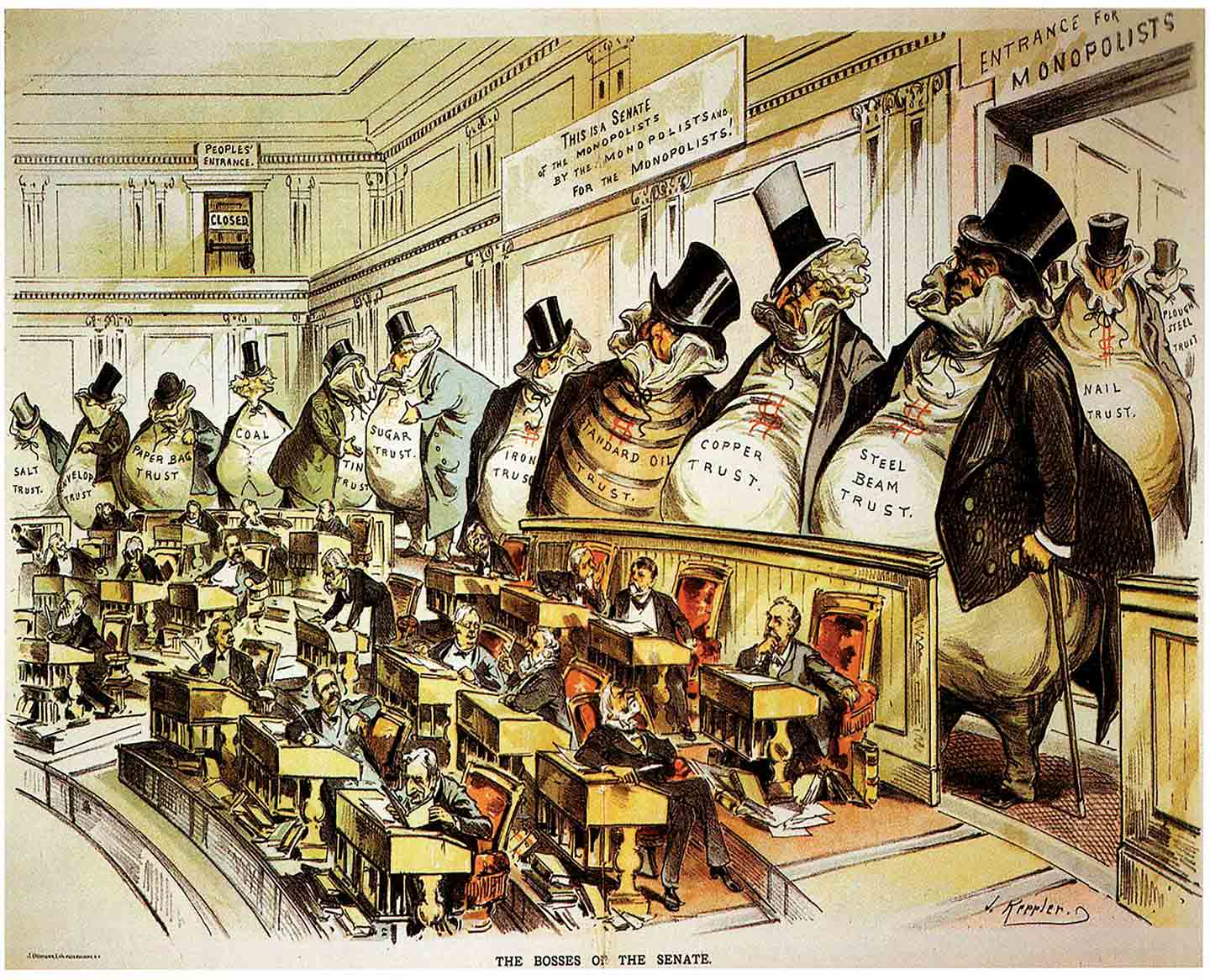
‘'The Gilded Age: A Tale of Today' was a satirical novel written by Mark Twain and Charles Dudley Warner, which was first published in 1873. The book’s title became synonymous with graft, materialism, and corruption in American public life in the years after the end of the Civil War.
The Irish Interest in the Gilded Age


The Gilded Age, Political Corruption and Genocide of Native Americans
Native Americans were granted citizenship rights under a 1924 Act but full citizenship and suffrage rights only in 1948, because state law governed voting rights.
According to a Department of Interior survey, seven states still refused to grant Indians voting rights in 1938. Discrepancies between federal and state control provided loopholes in the Act's enforcement.
States justified discrimination based on state statutes and constitutions. Three main arguments for Indian voting exclusion were Indian exemption from real estate taxes, maintenance of tribal affiliation, and the notion that Indians were under guardianship or lived on lands controlled by federal trusteeship.
By 1947, all states with large Indian populations, except Arizona and New Mexico, had extended voting rights to Native Americans who qualified under the 1924 Act. Finally, in 1948, the states withdrew their prohibition on Indian voting because of a judicial decision.
The term "Native American" began replacing "Indian" in mainstream U.S. usage during the 1960s, driven by social justice and activist movements seeking more accurate terminology.

