

In 1958, Jean-Baptiste Nicolas Robert Schuman became the first President
of the European Parliamentary Assembly (later the European Parliament)
In 1950, the Schuman Declaration proposed a joint coal and steel authority between France and West Germany, helping avert future conflict and leading to the European Coal and Steel Community (ECSC).
Schuman, the French Foreign Minister, with his colleague Jean Monnet, a member of the French government, made history.
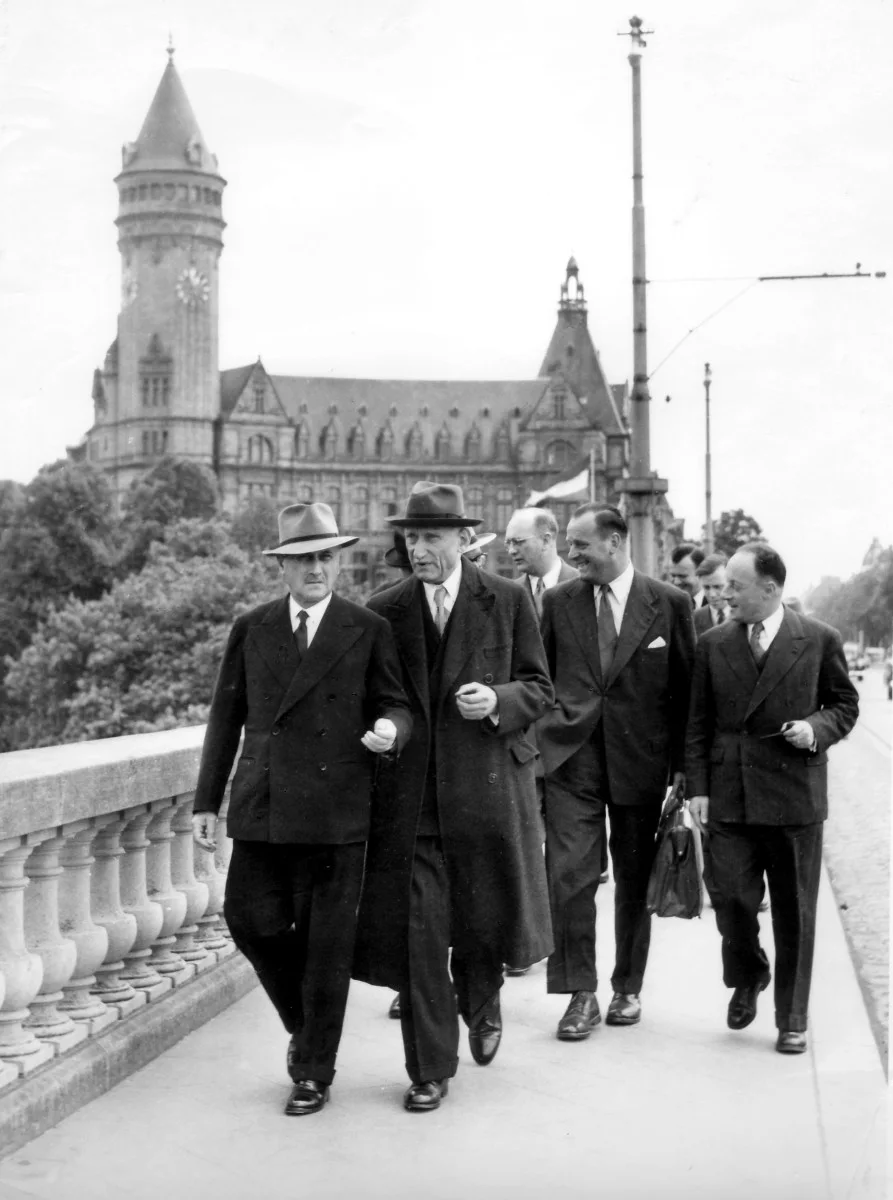
From left to right, Jean Monnet and Robert Schuman in Luxembourg, 1953
The Six Founding Countries
- France
- West Germany (Federal Republic of Germany)
- Italy
- The Netherlands
- Belgium
- Luxembourg
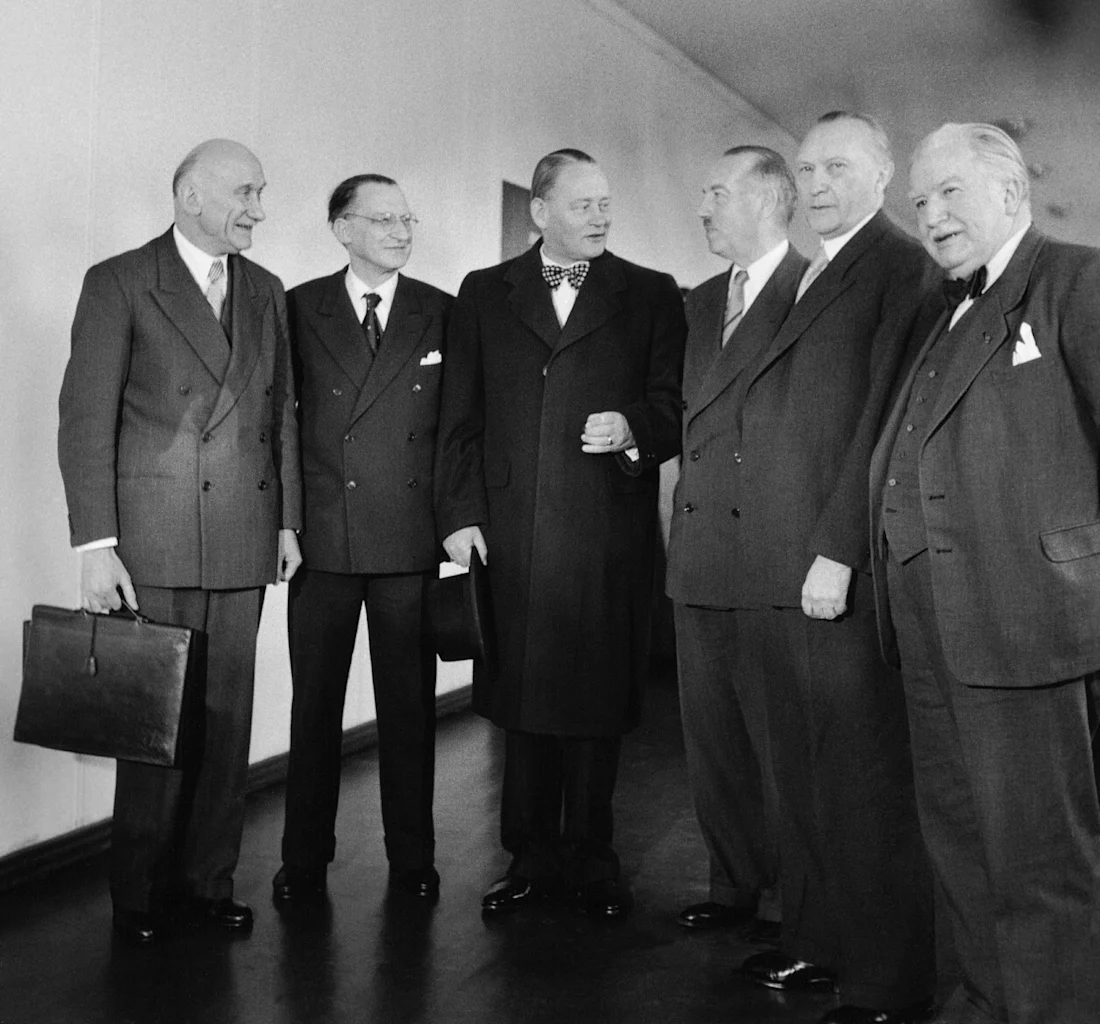
- France: Robert Schuman (Foreign Minister who proposed the plan) and Jean Monnet (political-economic adviser and architect of the plan).
- West Germany: Konrad Adenauer (first Chancellor of West Germany).
- Italy: Alcide De Gasperi (Prime Minister and Foreign Minister).
- Belgium: Paul-Henri Spaak (Prime Minister and prominent diplomat).
- The Netherlands: Johan Willem Beyen (Foreign Minister) and Sicco Mansholt (agricultural policy planner).
- Luxembourg: Joseph Bech (Prime Minister and Foreign Minister).
Robert Schuman (1886–1963), the ‘Father of Europe’, became a world-famous French politician after the Schuman Declaration of 9 May 1950, which gave birth to today's European Union.
Key Details
- Purpose: The plan aimed to make future war between historic rivals like France and Germany materially impossible by sharing control over vital war materials (coal and steel).
- Next Steps: Following the declaration, these six nations signed the Treaty of Paris on April 18, 1951, officially creating the ECSC.
- Legacy: This shared economic authority served as the foundational building block for the modern European Union.
The British Government’s response to the 1950 Schuman Declaration evolved from cautious diplomacy into a definitive refusal to participate. Although Prime Minister Clement Attlee’s Labour government supported Franco-German reconciliation, Britain ultimately declined to join the negotiations that created the European Coal and Steel Community (ECSC).

A British newspaper in 1950. It supported the Labour Party
The primary reasons for the British government's rejection centred on issues of national sovereignty and economic strategy:
1. Rejection of Supranationalism
The core of the Schuman Plan was the creation of a supranational "High Authority" whose decisions would bind member states.
The British Cabinet strongly opposed surrendering national sovereignty to an independent, unelected European body. The British position was that international cooperation should be intergovernmental—meaning governments retain veto power—rather than supranational.
2. Protection of Nationalised Industries
At the time, the Labour government was actively implementing its domestic socialist agenda, which included the recent nationalisation of the British coal and steel industries. The government was deeply unwilling to hand over control of these freshly nationalised, vital sectors to a European authority, fearing it would interfere with domestic economic planning, employment policies, and production quotas.
3. The "Three Circles" Doctrine
British foreign policy at the time was governed by the "Three Circles" doctrine, which prioritised Britain’s global standing. The government placed its relationship with the British Empire and the Commonwealth first, its "Special Relationship" with the United States second, and Continental Europe a distant third. Britain did not view itself as primarily a "continental" power and feared European integration would disrupt its global trade ties.

Timeline of the British Response
- May 11, 1950: Two days after the declaration, Prime Minister Clement Attlee gave a statement to the House of Commons welcoming the French initiative to bridge animosities with Germany but remaining non-committal about UK involvement.
- May 26, 1950: The British Embassy in Paris officially communicated the UK’s initial reservations regarding the plan's supranational terms.
- June 3, 1950: The British Government issued an official press release definitively declining the invitation to join the founding six nations in intergovernmental negotiations.
- June 26–27, 1950: The Schuman Plan was heavily debated in Parliament. The Conservative opposition, led by Winston Churchill, criticised the government for failing to join the talks to shape the project from within, though Churchill himself also favoured an independent Britain allied with Europe rather than absorbed by it.
This pivotal decision sidelined Britain from the early stages of European integration, a position it would spend the next two decades trying to reverse before finally gaining entry to the European Economic Community in 1973.
The European common market, officially established by the Treaty of Rome in 1957, was created to integrate European economies and boost growth through free trade.
Origins and Founding Members
- Creation: Signed on March 25, 1957, and started in January 1958.
- Founders: Belgium, France, Italy, Luxembourg, the Netherlands, and West Germany.
- Original Name: The European Economic Community (EEC), widely called the "Common Market".
Core Goals
- Trade: Remove customs duties and import quotas between member nations.
- Rules: Set a common trade policy for countries outside the group.
- Freedoms: Allow the free movement of goods, services, capital, and labour (workers).
Evolution into the European Union
- Single Market: Grew into a deeper economic union with fewer barriers by 1993, known as the internal market.
- Modern EU: Formed the core foundation of the modern European Union (EU) used by 27 member states today.
UK, Denmark and Ireland joined the EEC in 1973
Historical Background
- Prior delays: The UK and Denmark applied in the 1960s, but French President Charles de Gaulle blocked British entry twice.
- Economic ties: Denmark and Ireland joined alongside the UK because their economies relied heavily on British trade.
- Public approval: Ireland and Denmark approved membership via national referendums in 1972, while the UK later held a referendum on staying in the EEC in 1975.
Robert Schuman is called the "Father of Europe"
Robert Schuman (1886–1963) is called the "Father of Europe" because he created the plan for peace and cooperation that led to the European Union.
The German Empire created Alsace-Lorraine as an imperial territory in 1871 after defeating France in the Franco-Prussian War.
Who Was Robert Schuman?
- Early life: Born in Luxembourg in 1886, he grew up with German and French cultures and became a French citizen in 1919.
- Wartime trials: During World War II, he joined the French Resistance and hid from the Nazis after escaping arrest.
- Political roles: He served as the Prime Minister of France twice and as the French Foreign Minister.
The Schuman Declaration
- The date: On May 9, 1950, he presented the Schuman Declaration.
- The goal: He proposed joining the French and German coal and steel industries under a single shared authority.
- The result: This bold step made future wars between France and Germany nearly impossible and created the first European community.
Legacy of Schuman
- Europe Day: May 9 is now celebrated as Europe Day to honour his vision.
- First President: He served as the first President of the European Parliamentary Assembly from 1958 to 1960.
- Venerable status: Pope Francis declared him venerable in 2021 on his path toward potential sainthood in the Catholic Church. The cause for his beatification remains active, and the Church is awaiting the official verification of a miracle attributed to his intercession before he can be beatified.
Personal Life and Celibacy
- Lifelong Bachelor: Robert Schuman remained unmarried throughout his life.
- Religious Devotion: He was a devout Catholic. He lived a modest, celibate life and briefly considered entering a monastery in his youth before committing himself to a lay political career. The basis for building greater peace and unity (VATICAN MEDIA)

During his apostolic journey to France in September 2026, Pope Leo XIV travelled to Metz—Schuman's hometown and final resting place—to pay homage to the European founding father and promote peace and EU unity. However, the Pope's visit did not change Schuman's official canonical status.
Disscussion
The 1950s marked the beginning of the longest period of continuous peace in Western Europe since the fall of the Western Roman Empire in 476 AD, when Odoacer overthrew Romulus Augustulus.
This era of stability, often called the Pax Europaea (Europeans Peace), began after the devastation of World War II.
While there were centuries of frequent conflicts between European powers before 1945, the creation of economic alliances in the 1950s—like the European Coal and Steel Community in 1951—bound former rivals France and Germany so closely together that war became, as the founders stated, "not merely unthinkable, but materially impossible."
This cooperative framework eventually evolved into the modern European Union, sustaining a historic stretch of peace that has lasted for over 80 years.
