Thursday, April 19, 2007

Irish Hospital Consultants, Mickey Mouse Pay and Europe's Highest Paid Health Minister!

The usual line taken in the media by representatives of powerful professional groups such as teachers and medical consultants is to try and downplay the main issue - more money - by spinning the yarn that it's the interests of children and patients that are the primary motivator.

One medical consultant left the cat out of the bag when he termed a salary of €205,000 pus a bonus of €40,000 for a 39-hour week as 'mickey mouse'. It must be hard for an individual like that to understand or care to understand, what life is like for a patient on the average annual industrial wage of €32,000.

The gilded trade unionists in the Irish Hospital Consultants Association, crowed in relation to the Government's decision to advertise for consultants who would have to work solely in the public hospital service rather than continue on a gravy train of juggling work in both private and public hospitals:

"We are about to be assailed by spin doctors from the HSE and the Department of Health on why we need to urgently employ medical doctors even if they are of less qualification than the best candidates available within and outside this jurisdiction. The Minister and HSE have got their answer from the junior doctors of today who are the consultants of tomorrow. Several groups of Specialist Registrars who are qualified to apply for consultant posts have taken the long view and decided not to apply for the controversial positions."

How wise that these mighty people would take the long view without any intimidation?

Indeed and how similar to the partyspeak that was common in the once Communist Empire in Eastern Europe and the Soviet Union!

It takes spinners to recognise ones and as militant trade unionists, they used an old trick - anyone who would dare apply for an advertised post would be blackballed and given the Captain Boycott treatment.

Meanwhile Health Minister Mary Harney, was welcomed to the conference of the Psychiatric Nurses Association in Ballybofey, County Donegal, as Europe's highest paid Health Minister.

Liam McNamara Chairman of the PNA said that Harney and other politicians have got the biggest increases from the public sector pay bonanza - 30% more than other public staff.

Since 1997, Ministers, TDs and Senators have seen their pay rise by 119% - double the average industrial wage rise of 60%.

Overpaid Legislators: 30% Special Pay Awards including Sham Benchmarking and Pay up 119% since 1997 - Average Weekly Industrial Earnings up 60%

Ireland has 166 members (TDs) in the lower parliament chamber Dáil Éireann who represent some 4.2 million people. With one TD for every 25,000 persons, the people are over-represented in parliament, and their representatives are, by international comparison, overpaid as national legislators.

However, following the latest census of population, Ireland may even get more.Joseph O'Malley, Political Correspondent of the Sunday Independent recently wrote that Ireland has far more TDs than Britain has MPs: four times as many in proportional terms.

The TD in Leinster House is now better paid than his or her counterpart at Westminster. The TD also enjoys superior pension benefits, and for a much lower pension contribution: 6 per cent of a TD's salary, while the MP pays 10 per cent.

O'Malley says that for the TD, the transformation from being underpaid to being overpaid represents a remarkable turnaround in a short time. The TDs, however, are not complaining.

Within a decade, few sectors of society have done better in pay terms than the political class at Leinster House.In 1997, the Westminster member was paid a quarter more than the TD, who then earned €44,067. Nine years later the TD/MP pay gap has not just been closed, it has been reversed.

Today, the Dáil deputy earns €96,650 and the MP earns 11 per cent less, at €87,132.

O'Malley writes: Few can seriously dispute that the TD has less onerous national responsibilities than his British counterpart. The Dail sits less often than the Commons, and parliamentary life is much less demanding in Leinster House than at Westminster.

Never mind that Britain's population is 15 times larger. And its economy is 11 times the size of the Irish economy. The TD represents fewer people in a much smaller country. Nevertheless, Dail deputies are now paid more than MPs to do a less challenging job.

The key to the current high salary status of TDs has been the conjunction of some remarkable series of developments on the pay front. First, in 1999 the Buckley pay review awarded TDs a special pay increase of some 18 per cent. Buckley also recommended that Dáil deputies' pay should be linked to that of a principal officer in the civil service. Second, in 2002 the benchmarking review recommended a 12 per cent pay rise for principal officers.

And because TDs were linked to principal officers, they also benefited from that award. Since 1997, the 30 per cent from the special pay awards, when added to the normal partnership pay rises, has meant that the pay of Dail deputies has more than doubled. It is up 119 per cent, or twice as rapidly as the average industrial wage.

Stephen Collins in The Irish Times reported last July that politicians received their fourth pay rise in a year at the beginning of June, bringing the basic salary of a TD to €96,560 before special allowances and expenses are taken into account.

For the Taoiseach and his Ministers, it was the sixth pay rise over the past 12 months. Mr Ahern's salary is now €258,730 a year, including his TD's salary, while the Tánaiste earns €222,256 and other members of the Cabinet get €204,020.

Each Government minister has got 2 benchmarking awards, even though everyone knows that the system has been an absolute scam.

A comparable country to Ireland, such as New Zealand, which is similar in population size (4.1m) and economic scale and performance to Ireland, manages with 121 MPs, one chamber, and no upper house.

Indeed in 1999, in a non-binding referendum, the New Zealand people voted to reduce the number of MPs to 99: some 84 per cent voted in favour. Even more remarkable: the Kiwi MP is paid just €56,730, under two thirds the Irish rate.

Joseph O'Malley in The Sunday Independent, says that a contribution of only 6 per cent of salary entitles TDs to a full pension after just 20 years, based on half their final salary, and with a lump sum payment of one and a half times that salary.

But what the TD pays for his pension bears no relation to the real economic cost of providing his retirement benefits. The taxpayer pays that extra, unquantified, cost.

In a damning indictment of the current wide gap between many of the governed and their legislators, O'Malley writes: Many private sector companies are closing their defined benefit (final salary) schemes to new entrants, while others raise contributions to close the funding deficit, which the law passed by the Oireachtas requires.

Remarkably, however, little echo of this great debate on pensions can be heard in the national parliament.To cap it all, part-time local councillors are seeking public occupational pensions even though most private sector workers beyond the foreign-owned sector and large Irish-owned companies, such as banks and public companies, have none!!

The Sunday Independent has reported that thirteen Government ministers have benefited from tax breaks, averaging almost €5,000 each on second homes in the capital, just weeks after the Taoiseach's brother Noel Ahern, said property speculators should be "taxed out of existence".

The break designed exclusively for members of the Government, allows ministers to claim relief on second homes and for overnight accommodation in Dublin. Latest figures reveal that 13 ministers availed of the perk, claiming €63,477 between them.

So when Mary Harney lectures the nurses on pay, her credibility is at issue given the she is among the small elite in the public service who have got the biggest pay increases.

Monday, April 16, 2007

The Politics of Irish Jobs Announcements

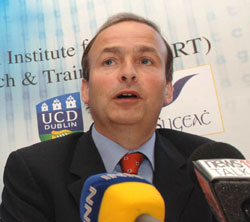
Micheál Martin TD, Minister for Enterprise, Trade & Employment
Irish enterprise agencies are required to inform ministerial office staff at the Department of Enterprise, Trade and Employment on any development where either the senior minister or two junior ministers can claim credit for via a press release.

Jobs announcements are the manna to spin the yarn while there is no monthly ministerial claim for credit in respect of redundancy data.

In recent weeks, in advance of the general election and with a raft of unwelcome plant closure announcements, the sparse weekly jobs announcements have usually been preceded by a leak.

So news jobs have been unofficially announced in the weekend newspapers and then, in succeeding days, there is the ministerial imprimatur on the number of "high calibre " jobs that will be created and lots of blah-blah.

Last week, there was an announcement from Minister for Enterprise, Trade and Employment Micheál Martin TD that US firm Paragon Global Resources is to locate its international headquarters in Blanchardstown, Co. Dublin, with the support of IDA Ireland. The total investment will be €3.7 million over five years and will create up to 100 new "high level positions."

Today Monday, Martin announced that DeCare Systems Ireland Limited, a unit of a US firm, is to "undertake a strategic expansion of its business at the University Technology Centre, Cork". With the support of IDA Ireland, the expansion will create 100 new high level positions over five years, Martin said.

Apart from the apparent coincidence of the same number of jobs over the same time period, to have a time period of five years for creating jobs, is ridiculous. So it is an aspiration.

The five-year time period appears to be politically motivated to boost the number of jobs in an announcement.

Thursday, April 12, 2007

McDowell, Ethics Bill, Planning Tribunal and Continuing Corruption


Last October, within a month of becoming leader of the Progressive Democrats and Tánaiste, Michael McDowell promised an Ethics Bill in the aftermath of the revelations that the Taoiseach Bertie Ahern had received cash payments from various individuals to alleviate the requirements of a post-marital break-up settlement, six years after a formal separation.

Bertie Ahern agreed with McDowell's proposals to ban private gifts for politicians, as a face-saver for the latter who had a choice of supporting Ahern's ethics standards of the early 1990's or sit on the Opposition benches.

On Wednesday this week, legislation requiring politicians to seek advance approval for substantial gifts from friends, also included a provision that provides for tripling the amount of money they can receive without having to declare the contribution.

Under the Ethics in Public Office (Amendment) Bill, Irish politicians must not accept more than €2,000 from friends for personal reasons unless they get approval from the Standards in Public Office Commission. But gifts or donations under €2,000 would not have to be declared, more than three times the current threshold of €650.

Political analysts say that the Bill has little chance of becoming law before the Dáil is dissolved for the general election.

In a radio interview, McDowell said that when for example he received hospitality from the organisers of the Ryder Cup last September, he shouldn't have had to declare such benefits.

The Ryder Cup example is a very pertinent one as the brown envelopes that former Government Press Secretary Frank Dunlop and more recently, bagman for builders, seeking to buy off local politicians, told the Planning Corruption Tribunal that has been sitting for almost 10 years, the typical rezoning vote purchase cost about IR£2,000.

Not only has ZERO been done about the corrupt land rezoning system that spawned the planning corruption, Michael McDowell's PD colleague Tom Parlon views any change in the system that makes multi-millionaires of farmers near Irish towns, "to the left of Stalin." Farmers like Parlon getting most of their income from European taxpayers, are not socialists either!

So NOTHING has been done to change the corrupt rezoning system and anyone who believes that corruption has ended, is a fool.

The contemporary Frank Dunlop in the guise of bagman, has dispensed with the brown envelope and has a much wider range of bribes/inducements under the umbrella of "corporate entertainment."

The Irish Independent reported in September 2006, that Menolly Homes, which paid former Fianna Fail TD Liam Lawlor £40,000 to get a better postal address for its homes, had offered a clutch of South Dublin councillors expensive gifts of Ryder Cup tickets and corporate hospitality.

The Financial Times reported earlier in 2006, before the 2006 World Cup that City investment banks in London, flushed with record earnings were snapping up most of the corporate hospitality packages available to British companies.

The London banks had already secured about 20,000 tickets, more than 70 per cent of the corporate packages being sold in the UK.

The FT said that Champagne and fine-dining packages ranged from €900 (£618) for a single match to as much as €300,000 for a luxury corporate box holding 10 people.

In Germany, 80 per cent of the total of 350,000 corporate tickets were available for local companies and the biggest bank Deutsche Bank headed the buyers' list. Seven-game packages priced at €15,000, which would allow a punter to follow England all the way to the final, have already been sold out.

So McDowell brings in an Ethics Bill that is unlikely to be passed while he and is colleagues have sat idly by for a decade and our rezoning system remains a golden tabernacle of vested interests and another Irish solution for an Irish problem.

In his radio interview on Thursday, McDowell suggested that when a minister gets a crate of wine from a chamber of commerce, he or she should not be required to refuse it.

The biggest loophole is in self-valuing the gift.

Some recipients like Michael McDowell, may know the value of a crate of Château Petrus - others would genuinely not!

Surely McDowell knows that more often than not, a "gift" is a legally-wrapped bribe?

It's also indeed indicative of how much the Progressive Democrats' leadership has surrendered to maintain the spoils of office, that the man who opposed single party Government, has made a proposal that even a Fianna Fáil minister with the thickest brass neck, would unlikely do.

Global corruption rampant; Corporate entertainment the new bribery in Developed World

Tuesday, April 10, 2007

Climate Change Impacts Respect no Borders

Visiting Chinese Premier Wen Jiabao (L front) shakes hands with the Republic of Korea President Roh Moo-hyun during their meeting in Seoul, capital of the Republic of Korea, April 10, 2007. (Xinhua Photo/Rao Aimin)

This is the time of year when the winds from the Gobi desert in Mongolia and Northern China sweeps yellow sands across to the Korean Peninsula.

The annual April storms keep children indoors, ground aircraft and create problems for precision industries such as semiconductors.

The Financial Times reports today that after a mild winter that deposited little snow in the Mongolian deserts, experts, including the Korea Meteorological Administration, believe 2007 could be the worst on record.

In the 1980s South Korea suffered severe yellow dust storms on about four days a year but that increased to an average of eight days a year in the 1990s and has reached more than 12 days a year this decade, according to the environment ministry, reflecting global warming.

The sand from the Gobi desert is becoming ever drier. Diminishing snowfalls mean the sand is not bound together as closely as in previous years.

The sand, which carries high levels of iron and manganese, picks up dioxins and heavy metals such as copper, cadmium and lead as it travels across the polluted industrial areas of northern China.

The Korea Environment Institute estimates as many as 165 South Koreans, mainly elderly people and those with respiratory problems, die each year and almost 2m more suffer from eye and breathing problems as a result of the sand.

Last year 4,373 schools closed for at least one day, while 164 flights were cancelled and many more aircraft were forced to change flight paths.

The Samsung Economic Research Institute estimates the economic damage from yellow dust at $5.5bn annually.

The FT says that Hynix and Samsung Electronics, both big computer chip makers, have increased the time employees spend in "air showers" on the way into their high-technology plants. Carmakers are forced to change the air filters in their spray-painting factories more often.

Still, for some businesses the seasonal storms also represent an opportunity: LG and Samsung have both produced new air-purifiers with enhanced dust removal mechanisms.

Meanwhile, supermarkets report mask sales have doubled or tripled from last year and restaurants are even selling more samgyopsal, a fatty pork dish said to be good at cleaning out dust from the inside when consumed.

Government officials from China, Korea, and Japan, which suffers to a lesser degree, have been meeting to help Mongolia plant more trees to create a green belt across the Gobi desert, and are giving $1.2m to Korean environmental groups to promote forestation. But it will be a slow process.

Monday, April 09, 2007

Irish Road Safety and John Waters' Metaphysical Ramblings

BBC's Top Gear programme is a popular programme because of its focus on high-speed cars. Presenter Richard Hammond has returned to the programme after a serious crash last September in a jet-powered car while filming for the programme. Hammond had been in a dragster-style car capable of reaching speeds of about 300mph at Elvington airfield near York.

A noticeable difference between my school days and today is that on a weekday afternoon, it is rare these days in Dublin, to find people staggering blind drunk out of pubs and proceeding to drive a vehicle. In contrast, it was far from rare in Bandon, West Cork. Twenty miles west, Dunmanway had a reputation for the amount of gargle available at funerals and the bottles of poitín or whiskey would be passed around in the graveyard.

While the amount of driving while being blind drunk, has fallen significantly in recent decades, most Irish teens regard the consumption of a lot of alcohol as an essential part of socialising.

Young men and not so young men are smitten by fast cars as the popularity of the BBC programme can testify to. Presenter Jeremy Clarkson's sidekick Richard Hammond, having recovered from a high-speed test car accident last year, is back on the testosterone-fuelled programme.

So for young Irish male drivers, the combination of drink and fast cars is a powerful cocktail.

An example of poor attention to public safety - Dubliners are very familiar with cracked pavements that can go unrepaired for months or years. There are also plenty other examples of the lackadaisical attitude to public safety. Dublin City Council has a marked car space directly in front of the south exit of the Merrion Inn pub on Merrion Road above. Motorists swinging left into the petrol filling station, sometimes without significantly reducing speed, put pedestrians at risk. Think of the risk on a dark wet night, with pedestrians exiting the pub and a moving car with limited or no visibility on its left, just about to cut across the footpath.
Irish Times columnist John Waters looks at the world through a more opaque prism.

This is part of what John Waters presented to readers in today's issue:

...a comparison between our out-of-control male driver and the suicide bomber in some Muslim cultures. The context is different, but they seem both to be expressions of a perversion, a short-circuiting of meaning.

Ideally, a child needs to grow up in a coherent tradition which, while transmitting its own principles with love and conviction, is open enough to enable the testing of its value system against others. The element in Islamic cultures provoking the emergence of the fundamentalist extremist appears to be the rigidity of the tradition and its poor adaptability to different forms of reality.

When Islamic culture is transplanted into a secularised, hyper-liberal environment, a host of complexes are created in the minds of some youngsters, who react by plunging deep into the tradition. Our culture is, in a sense, the opposite.

Having recently emerged from rigid tradition into a virtual free-for-all, we have replaced our prior insistence on the conveyance of a singular notion of meaning with a pick-and-mix culture in which the child is left struggling to comprehend reality. This, for the reasons already stated, affects males more than females.

The signals picked up by the young man tell him that he may find his meaning and identity as an entrepreneur, a sportsman or a plumber. But, because he is primed with questions that go far deeper than business, sport or plumbing, this provokes in him an extreme reaction not dissimilar in psychological terms to the reaction of the young Muslim man who, unable to reconcile the eternal culture with what he has been taught, dives backwards for reassurance into the deepest, darkest parts of the tradition.

The young Irishman, lacking this option, plunges forward in a hedonistic rush, and, because he finds himself on quicksand, speeds up to stay above ground. The two are equally out of control, but seek different ways to answer back.

One straps himself around with explosives and walks into a city. The other, perhaps less consciously, gets behind a steering wheel, puts the pedal to the metal and explodes onto a country road.

- isn't life complicated enough without having to jump on a pop-psychology bandwagon?

The recent change in the attitude of the Government to road safety issues will take a long time to have an impact.

The obsession of each new generation with drink will not change in just a decade or two. In addition, in our system of governance, where there is little public accountability, the evidence is everywhere of a lackadaisical attitude to public safety as exemplified by the Merrion Road case cited above.

Friday, April 06, 2007

Power, Money and the link with Behavioural Inhibition

A Ferrari Enzo
The focus on the pay bonanza earned by new Ford Motor Co. CEO Alan Mulally for four months on the job in 2006, has again raised the issue of when enough is enough when it comes to hired-hands hoovering up for themselves and their families, as much as they can lay their hands on.

Mulally earned $28.2 million from Sept 1st, 2006 after joining from Boeing Co. to restore profit. Mulally's total compensation in 2005 at Boeing, his last full year with that company, was $9.96 million, including $7.58 million in long-term incentive pay. Ford had a $12.7 billion loss for 2006.

At a certain point, as money keeps piling in, the super-rich can lose track of how much they actually have (SEE: Who cleans up at Goldman Sachs?) but lots of money confers power and status.

In the age of globalisation, where superearners take the lion's share, while the earnings of many workers in the Developed World are under threat from free trade, there are serious long-term implications.

Lots of money also makes people behave like idiots!

The experience of US comedian Eddie Griffin in writing off film producer Daniel Sadek's $1.5 million Ferrari Enzo, after piloting the hyper exotic car into concrete retaining wall, a year after Swedish videogame tycoon Stefan Eriksson smashed his Enzo — one of only 400 ever made — into a telephone pole, had prompted Sadek to say: “Eddie came out of the crash OK”, and that “A lot of worse things are happening in the world.”

Richard Conniff, author of The Natural History of the Rich: A Field Guide, writes in the New York Times: So what exactly constitutes a bad day in this rarefied little world? Did the casino owner Steve Wynn cross the mark when he put his elbow through a Picasso he was about to sell for $139 million? Did Mel (“I Own Malibu”) Gibson sense bad-day emanations when he started on a bigoted tirade while seated drunk in the back of a sheriff’s car? And if dumb stuff like this comes so easy to these people, how is it that they’re the ones with all the money?

Conniff refers to an experiment lead by Professor Dacher Keltner, a psychologist at University of California - Berkeley, who says that power and status imbue almost every facet of social interaction, from linguistic convention to the economy of emotional expression. Keltner also says that elevated social status leads to disinhibited social behaviour.

Mugshot of actor Mel Gibson - - A report on Gibson's behaviour following his arrest for drunk driving in July 2006, said that once inside the Sheriff's car, a source directly connected with the case said that Gibson began banging himself against the seat. The report says Gibson told the deputy, "You mother f****r. I'm going to f*** you." The report also says "Gibson almost continually [sic] threatened me saying he 'owns Malibu' and will spend all of his money to 'get even' with me."

The report says Gibson then launched into a barrage of anti-Semitic statements: "F*****g Jews... The Jews are responsible for all the wars in the world." Gibson then asked the deputy, "Are you a Jew?"

Researchers led by Keltner took groups of three ordinary volunteers and randomly put one of them in charge. Each trio had a half-hour to work through a boring social survey. Then a researcher came in and left a plateful of precisely five cookies. Care to guess which volunteer typically grabbed an extra cookie? The volunteer who had randomly been assigned the power role was also more likely to eat it with his mouth open, spew crumbs on partners and get cookie detritus on his face and on the table.

It reminded the researchers of powerful people they had known in real life. One of them, for instance, had attended meetings with a magazine mogul who ate raw onions and slugged vodka from the bottle, but failed to share these amuse-bouches with his guests. Another had been through an oral exam for his doctorate at which one faculty member not only picked his ear wax, but held it up to dandle lovingly in the light.

Conniff says that as stupid behaviours go, none of this is in a class with slamming somebody else’s Ferrari into a concrete wall. But science advances by tiny steps.

The researchers went on to theorize that getting power causes people to focus so keenly on the potential rewards, like money, sex, public acclaim or an extra chocolate-chip cookie — not necessarily in that order, or frankly, any order at all, but preferably all at once — that they become oblivious to the people around them.

Indeed, the people around them may abet this process, since they are often subordinates intent on keeping the boss happy. So for the boss, it starts to look like a world in which the traffic lights are always green (and damn the pedestrians).

Professor Keltner and his fellow researchers describe it as an instance of “approach/inhibition theory” in action: As power increases, it fires up the behavioral approach system and shuts down behavioural inhibition.

And thus the Fast Forward Personality is born and put on the path to the concrete barrier.

The corollary is that as the rich and powerful increasingly focus on potential rewards, powerless types notice the likely costs and become more inhibited.

The bottom line for Conniff is: Without power, people tend to play it safe. Given power, even you and I, would soon end up living large and acting like idiots.

Power, Approach, and Inhibition

This article examines how power influences behaviour. Elevated power is associated with increased rewards and freedom and thereby activates approach-related tendencies. Reduced power is associated with increased threat, punishment, and social constraint and thereby activates inhibition-related tendencies.

Monday, April 02, 2007

Irish Nurses: Politicians don Hairshirt late in day having been huge gainers from Public Sector Pay Bonanza

The Irish nurses in public hospitals have begun industrial action to press home their claims for a reduction in their working week from 39 hours to 35 hours and a special pay increase of 10%.

Some other groups in the health service have better terms than them and why wouldn't they try to get a piece of the free lunch like so many others, including politicians?

During the dot-com period of temporary insanity, teachers and other public servants bought into the self-serving delusion that stories on the small number in the private sector like Fran Rooney who hit the jackpot with the Baltimore Technologies floatation, were representative of private sector workers, rolling in manna from heaven, while the brethren in the public sector had to survive on thin gruel.

Taoiseach Bertie Ahern is not one for sailing against the wind and he agreed to the demands of public sector trade unions to set up a "benchmarking" body that was tasked with making comparisons between similar grades in the public and private sectors.

In the nod and wink world of Irish politics, the conclusions were agreed before the body was established and such minor issues as the gold plated pensions that were available to Bertie Ahern and others on the public payroll, compared with the zero coverage available to a large number of private sector workers, was conveniently ignored.

Before the benchmarking body was due to report, Senator Joe O'Toole who was then the general secretary of the Irish National Teachers Organisation, left the cat out of the bag when he said that benchmarking was like turning up at an ATM to withdraw cash. The use of the word "benchmarking" was a sham.

In December 2000, a Public Service Benchmarking Body, established under the Programme for Prosperity and Fairness (PPF), was asked to undertake "a fundamental examination of the pay of public service employees vis-a-vis the private sector." Former Davy Stockbrokers' economist Jim O'Leary was a member of the body for a period but he resigned before it reported.

In 2004, O'Leary who had joined the Department of Economics at Maynooth University, published with two of his colleagues, the results of six months' rigorous and painstaking research into public-private sector pay differentials in Ireland - Public-Private Wage Differentials in Ireland, G.Boyle, R.McElligott and J.O'Leary, ESRI Quarterly Economic Commentary, Summer 2004.

O'Leary and his colleagues wanted to discover whether similar people in similar employment circumstances were better or worse off working in the public than in the private sector. In order to do this, they had to control for attributes like age, experience, gender and education, and also for job characteristics like occupation, type of contract and size of establishment.

As the CSO (Irish Central Statistics Office) data does not permit this kind of analysis, the dataset that they had to use, is one based on a large-scale survey conducted by the Economic and Social Research Institute (ESRI) and used for much of its research into poverty and inequality.

The core finding was that on average, public servants earned 13 per cent more than their private sector counterparts on a like-for-like basis in 2001.

The researchers also discovered that the size of this margin (the public sector premium) in 2001 was not significantly different from what it had been in 1994, suggesting that pay increases in the public sector had kept pace with the private sector throughout the Celtic Tiger period.

Another discovery was that the margin by which public service workers outearned their private sector counterparts tended to be significantly larger at the bottom of the income distribution than at the top.

A particularly striking finding was that the estimate of the public sector premium for Ireland was more than twice as large as the available estimates for other countries.

The Public Sector Benchmarking Body recommended pay increases which averaged 9 per cent across the grades examined and cost €1.2 billion a year. Government Departments introduced aspirational targets for staff that would make a laughing stock of a manager in the private sector, who emulated the farcical exercise.

O'Leary says that the Public Sector Benchmarking Body never published its research results and at no stage in its 278-page report did it explicitly state or opine that public sector pay had fallen behind that in the private sector.

Ministers, other politicians and all living former employees of the Irish public service received special payments. Bertie Ahern, Michael McDowell and the rest of the Cabinet got double benchmarking payments.

The gravy train didn't stop there.

Politicians' Pay

Total increases taken by Ministers and TDs since 1997, have jumped 119 per cent, or twice as rapidly as the average industrial wage.

In 1997, the Westminster member was paid a quarter more than the TD, who then earned €44,067. Nine years later the TD/MP pay gap has not just been closed, it has been reversed. Today, the Dáil deputy earns €96,650 and the MP earns 11 per cent less, at €87,132.

Joseph O'Malley of the Sunday Independent wrote in 2006: Few can seriously dispute that the TD has less onerous national responsibilities than his British counterpart. The Dail sits less often than the Commons, and parliamentary life is much less demanding in Leinster House than at Westminster. Never mind that Britain's population is 15 times larger. And its economy is 11 times the size of the Irish economy. The TD represents fewer people in a much smaller country. Nevertheless, Dail deputies are now paid more than MPs to do a less challenging job.

The key to the current high salary status of TDs has been the conjunction of some remarkable series of developments on the pay front.

First, in 1999 the Buckley pay review awarded TDs a special pay increase of some 18 per cent. Buckley also recommended that Dáil deputies' pay should be linked to that of a principal officer in the civil service. Second, in 2002 the benchmarking review recommended a 12 per cent pay rise for principal officers.

And because TDs were linked to principal officers, they also benefited from that award. Since 1997, the 30 per cent from the special pay awards, when added to the normal partnership pay rises, has meant that the pay of Dail deputies has more than doubled.

It is up 119 per cent, or twice as rapidly as the average industrial wage.

Irish Public Sector Pay

Pay - Irish Public Service 2001-2006: Salaries up 59%; Payroll up 18% - 38,000 additional workers and Pensions up 81.3%: Average industrial wage rise in the period was 19%:

Irish public service salaries rose by 59% in the period 2001-2006 and the payroll expanded by 38,000 extra staff.

Increases in public sector over the period due to general rounds total €2,479m (or 24.3%), “special” pay increases (primarily Benchmarking) total €1,328m (or 13%), and other factors (such as extra numbers) total €2,193m (or 21.6%).

Stripping out the additional staff, the average increase was 38%.

The increase in the average industrial wage for a male worker in the period 2001-2005, was 19%.

- most private sector workers on the industrial wage do not have an occupational pension. So the disparity in gains is greater than the 100% difference in the period 2001-2006.

The Exchequer’s annual wages and pensions bill increased sharply from €10.2 billion in 2001 to €16.2bn last year, with what has been termed "benchmarking" accounting for up to €1.32bn of the rise.

Conclusion

Minister for Health Mary Harney is now telling the nurses that the country cannot afford a big pay increase or a reduction in hours worked.

It's a bit late in the day to don the hairshirt when Mary Harney and other politicians were happy to nod through sham benchmarking and other huge increases for themselves, as if they had somehow found the philosopher's stone that would transmute the good times of the Celtic Tiger property boom, into a permanent prosperity.

As to a postscript on sham benchmarking, with its joke targets, last January, the Taoiseach asked the OECD to put forward proposals on public sector reform - six months after the general election!

Saturday, March 31, 2007

Dick Roche as Pontius Pilate: Irish Water Pollution

As Minister for the Environment Dick Roche, engages in the blame game on responsibility for the water debacle in Galway, this is what the European Commission said on March 22nd, 2007 on the Irish Government's negligence on the provision of drinkable water:

The European Commission is sending Ireland a final written warning for failing to comply fully with a 2002 European Court of Justice (ECJ) ruling requiring drinking water supplies to be kept free of E.coli bacteria. It is sending Ireland a similar warning for failing to comply with a 2005 ECJ ruling requiring greater controls on polluting discharges to surface water by local authorities.

If the responses are unsatisfactory, the Commission may ask the ECJ to impose financial penalties on Ireland. The Commission is also referring Ireland to the ECJ for failing to give adequate rights to citizens to legally challenge decisions in cases involving environmental impact assessments and integrated pollution prevention and control. At the same time, action taken by Ireland to ban drift-netting of Atlantic wild salmon at sea has allowed a case to be closed.


Environment Commissioner Stavros Dimas said: “I am concerned that, more than four years after a court ruling, and despite substantial Government investments, a significant number of local authority and private water supplies still show a presence of e.coli. This needs to be resolved without further delay."

European Commission takes action to secure Irish clean drinking water as 60 people infected by water contamination in Galway

http://www.finfacts.com/irelandbusinessnews/publish/article_10009522.shtml

RTE Radio 1 Morning Ireland Programme, April 04, 2007 on water quality in Galway:

Environmental scientist Roderick O'Sullivan says he found huge levels of faecal contamination in a survey in 1995

Audio - Real Player should be installed

In the Irish Times on Saturday, March 31st, readers commented:

Madam, - In response to questioning on water pollution in Galway, Minister for the Environment Dick Roche repeatedly stated that he had allocated €21 million in 2002 to upgrade the water schemes in the county.

A preliminary report for a sewage treatment plant in Kinvara was submitted by Galway County Council to Mr Roche for his approval in October 2002. As a member of the Kinvara action group Cairde Cuan Chinn Mhara, I was a member of a delegation which met Mr Éamon Ó Cuív in an effort to speed up the process of approval. He told us very frankly that in his experience the longest hold-up in the process would be at the Department of Environment level.

Approval for the scheme was granted by the Department in December 2006 after a very active campaign by local people.Galway County Council have now - four years after the submission of its scheme - proceeded to detailed design and will then tender and finally commence construction.

Meanwhile, when you flush your toilet in the village of Kinvara, the waste exits directly into Kinvara Bay, which is itself an offshoot of Galway Bay, without filtration or treatment.

Why should communities have to spend time and effort in a prolonged effort to get what is a basic service? I have no doubt that there are many Kinvaras all over this country, after 10 years of economic boom.

Take a bow, Minister Roche.The buck stops with you. -

Yours, etc,

MARIA HANNIGAN, Cairde Cuan Chinn Mhara, Kinvara, Co Galway.

Madam, - At the recent Fianna Fáil Ardfheis, a motion was passed calling for the suspension of "no notice" cross-compliance farm inspections and the introduction of a 14-day notice period for all future inspections.

Similarly, the Fine Gael leader, Enda Kenny, met the IFA Executive Council on Wednesday March 21st, and promised that if Fine Gael were elected to government, "no notice" farm inspections would end and the IFA's demands for 14 days notice of such inspections would be met.

Cross-compliance relates to 19 management practices that farmers are required to implement if they wish to qualify for the Single Farm Payment. Four of the 19 practices relate to the prevention of water pollution.

At the same time, hundreds of people in Co Galway have contracted illnesses due to contamination of their drinking water supply, and over 90,000 people are boiling tap water before they can use it.

If it is the case that the contamination of the water supply in Co Galway is due to agricultural pollution, will Fianna Fáil and Fine Gael still honour these commitments to farmers? Or will they finally acknowledge that agricultural pollution of drinking water is a serious issue in the west of Ireland, and forego the electoral endorsement of the IFA in the interests of public health? -

Yours, etc,

GARRETH McDAID, Drumleague, Co Leitrim.

Madam, - I am not surprised to hear that Mr Dick Roche does not want "to get into the blame game". As Minister for Environment, he has ultimate responsibility for the public water supply.

It does not matter who is to blame; he is responsible for making sure nothing like this happens.

In other civilised countries he would be in serious trouble for an entire city being left with contaminated water - more particularly, contaminated with a parasite that can be spread from person to person.

Is there anything worse that could happen for which the Minister has responsibility? Will we find out about contamination anywhere else before half of us fall ill? -

Yours, etc,

CONAL WATTERSON, Patrickswell, Co Limerick.

As to Conal Watterson's rhetorical question, most people know the answer, if one is actually needed:

A Banjaxed System of Public Governance where the Buck Stops Nowhere

Wednesday, March 28, 2007

Woe Betide the Scaremongers and Doomsayers of the Irish Property Boom!

Praise the Lord and Pass the Ammunition!

When a leading spokesperson of the Irish property industry has to conjure up straw men, in a desperate defence of his sector, he is unwittingly revealing more vulnerabilities than apparently intended.

An article in last Sunday's edition of the Sunday Independent (25/03/07) by Ken MacDonald, Managing Director of estate agents Hooke & MacDonald, had echoes of Queen Gertrude in Shakespeare's Hamlet, reacting to to her alter ego's protestations of love to the king in the play within a play, with the line: "The lady doth protest too much, methinks."

As the Irish residential property market is begining to creak, it's not enough to have bank economists as cheerleaders but from the vantage of self-interested insiders, it appears that any questioning of the market's fundamentals, verges on high treason.

MacDonald wrote: Why do we allow scaremongers and doomsayers with unfounded pessimism and unbridled negativity dictate our thinking and blunt consumer confidence? The Irish economy is the envy of the world. Job creation is phenomenal with more than 7,000 new jobs being created each month - despite the gloomy attention given to periodic job losses in some sectors.

Unemployment stands at 4.1%, the lowest in Europe; there are 750,000 more people in the workplace than a decade ago. We have revitalised cities and towns, a conveyor belt of entrepreneurial business people operating successfully on a world stage, a rich cultural and artistic heritage, a vibrant talented young population, rising by almost 100,000 per year, confident in their own and their country's destiny. We should be celebrating our success on a daily basis. In any event, the Irish love affair with property will continue undaunted despite the knockers.

It would surely be something if we had found the philosopher's stone that would transmute our current good times, built on foreign direct investment, European Union transfers (we are still net beneficiaries from the EU budget) and a property boom, into a permanent prosperity.

Goodbody Stockbrokers - - Property-related taxes have been an especially important driver of tax revenues. While stamp duty is most visible in this regard, the biggest revenue gatherer is, in fact, VAT receipts from residential construction, which accounts for c.8% of total revenue. Goodbody estimates that property-related taxes have accounted for up to a third of the increase in the total tax take over the past two years. Property-related taxes now account for at least 17% of total revenues, up from 4% ten years ago. As the property market slows, the scope for further upside revenue surprises is limited.

The conveyor belt of entrepreneurial business people operating successfully on a world stage, is a delusion. It's one of those soundbites that provides the satisfaction of comfort food but has little shred of reality. We have our share of entrepreneurs but beyond, CRH, Ryanair and Digicel, how many other world-class companies, has the Celtic Tiger spawned?

On the world stage, we have certainly made a splash in one sector - commercial property investment - which amounted to €41 billion (equity and borrowings) in the period 2001-2006.

Irish Venture Capital investment in 2006 was €192m - equivalent to 0.024% of 2006 investment in overseas commercial property

The construction sector which has expanded from 126,100 people in 1998 to 281,000 today, is as big as the manufacturing sector, which has been underperforming, at a time when the global economy is in the fifth year of the longest sustained period of growth since the late 1960's. Some 17% of the private sector workforce are in the construction sector but we cannot engineer a permanent building boom.

Job creation is phenomenal with more than 7,000 new jobs..... This soundbite is trotted out by Taoiseach Bertie Ahern, Minister for Enterprise, Trade and Employment Micheál Martin and an army of parrots. It serves its purpose for those who haven't the breakdown.

The policy advisory agency Forfás, which reports to Micheál Martin's Department, said in January that employment growth in the Irish economy continued to increase in 2006, with construction, public administration, education and health accounting for 53,000 of the additional 83,000 jobs in the economy.

During 2006, employment levels supported by the development agencies (Enterprise Ireland, IDA Ireland, Shannon Development, and Údarás na Gaeltachta) increased by 5,927 to 305,062 – 2,913 permanent full-time jobs in foreign-owned companies, and 3,014 in Irish-owned companies.

Employment in Irish manufacturing rose by 2,900 in 2006, according to the CSO.

The balance of 24,000 jobs were in retail, distribution and services linked to domestic consumer demand that is built on the property boom.

Against a backdrop of a strong local and global economy, the 7% slice for jobs in the foreign-owned sector and Irish firms in manufacturing and internationally traded services, is hardly impressive.

Ken Mac Donald says that we should be celebrating our success on a daily basis...and...the Irish economy is the envy of the world. True indeed, and little factoids such as the 92% of Irish exports in 2006, which were made by foreign-owned firms, is just one of those little things that could be termed an inconvenient truth!

Comment - Irish Economy and Future of the Celtic Tiger: Putting a brass knocker on a barn door!

Tuesday, March 27, 2007

IPOD - - Insecure, Pressured, Overtaxed and Debt-Ridden

A recent feature in Newsweek magazine said that Europe has spawned a generation of "baby losers," society's 20-somethings who are missing out on the economic benefits that their baby-boomer parents took for granted but is the angst justified?

In the United Kingdom, the younger generation has been dubbed Ipod, for "Insecure, Pressured, Overtaxed and Debt-Ridden;" France has the "Génération Précaire" -- the precarious generation; in Germany, the well-educated members of "Generation Intern" accept unpaid jobs, hoping for a rare shot at a permanent position.

Newsweek says that young adults in France, like their contemporaries across Europe, face a slew of problems never experienced by their middle-aged leaders. Consider: a 30-year-old Frenchman who earned 15 percent less than a 50-year-old in 1975; now he earns 40 percent less. Over the same period, the number of graduates unemployed two years after college has risen from 6 percent to 25 percent, even if they typically have better degrees. Thirty-year-olds in 2001 were saving 9 percent of their incomes, down from 18 percent just six years before.

Young people who snag stable jobs, gain access to credit and buy homes later in life are particularly angry that the older generations continue to rack up public debts for which they will get the bill.

The older generation in many countries still enjoy the benefits of a generous welfare system that sees only 30 percent of Belgians older than 55 who still work, for example. A report by the London-based think tank Reform put the issue plainly. "People over 50 are developing the lifestyles of teenagers."

Newsweek says that some countries have so far avoided the malaise. In Ireland, the birthrate peaked late and the strong economy still provides jobs for all. In fact, "this is the first generation to have grown up in Ireland with no question that they would be able to find a job in the country," says Tony Fahey of the Economic and Social Research Institute in Dublin. Ditto for Spain, where everyone is enjoying the new prosperity and a welfare system vastly expanded since the end of the Franco regime. "[The young here] don't live worse than their parents; in fact they live much better," says Federico Steinberg, an economist at the Autonomous University of Madrid.

But even the happy Irish and Spanish share a housing problem. Across the continent, spiraling property prices and poor job prospects are conspiring to keep youngsters living at home. According to the Italian Institute of Social Medicine, 45 percent of the country's 30- to 34-year-olds still sleep in their old beds and enjoy Mama's home cooking.

In France, the proportion of 24-year-olds now living with their parents has almost doubled since 1975, to 65 percent. Even in the U.K., with its enviable record of job creation, the average age of the first-time home buyer has climbed from 26 in 1976 to 34 today. Property prices are now eight times higher than the median earnings of the ordinary twentysomething.

Matthew Lynn, a columnist for Bloomberg News says that "life has mostly improved for each generation since the Industrial Revolution of the 18th century. There is no reason to think that has changed now."

That is certainly true, in terms of improvements in medicine and many aspects of the quality of life. However, not all the post-war generation are doing well today, never mind the twentysomethings. For example, in Ireland the majority of private sector workers have no occupational pensions and in developed countries there is a growing income divide.

Young people with parents of property or properties of value, won't miss the boat. As to the rest, the pressures of globalisation will be a challenge and there is always the civil service for the French or Irish post the construction boom. A 2005 polled showed that 76% of French 15- to 30-year-olds aspired to civil-service jobs from which it's virtually impossible to be fired.

Sunday, March 25, 2007

The Irish and the Comfort of the Victims' Cross

Inishowen Peninsula, North-West Ireland, where in the words of the Chief Justice of Ireland "a stain of the darkest dye on the otherwise generally fine tradition of the Garda," was perpetrated against a citizen of a Republic and it has taken 14 years to get justice.

It's easier to see another's faults than our own, as it is collectively as a people.

Every wrong can be blamed on outsiders and it has usually been the British as far as we're concerned.

Following years of revelations about gross misconduct by gardaí (Irish police) in County Donegal, it has taken the Supreme Court to set out in the starkest terms, the "disreputable conduct and a shocking abuse of power" on the part of two members of the Garda who had conspired to concoct false evidence against him, resulting in perjured Garda evidence being given at his trial and his conviction.

For the innocent victim Frank Shortt, it was "a tormenting saga of imprisonment, mental and physical deterioration, estrangement from family, loss of business, public and professional ignominy and despair". He was "sacrificed in order to assist the career ambitions of a number of members of the Garda".

The 14-year nightmare for wrongly jailed Co Donegal nightclub owner Frank Shortt ended with a €4.7 million damages award from the Supreme Court, including an unprecedented €1 million punitive damages award, to mark the court's abhorrence of "outrageous conduct" by gardaí towards him.

The five-judge court increased from €1.9 million to €4.7 million the award of damages made to Mr Shortt by the High Court arising from his wrongful conviction and imprisonment on trumped-up charges that he allowed the sale of drugs at his former nightclub in Inishowen.

The award includes €1 million punitive damages to reflect the court's disapproval of what Chief Justice Mr Justice John Murray described as an affair which was "a stain of the darkest dye on the otherwise generally fine tradition of the Garda" and the "especially grave" abuse of Mr Shortt by two gardaí - Supt Kevin Lennon and Det Garda Noel McMahon. The damages were awarded against the State.

It has taken a public tribunal and more than a decade for the 72-year old Frank Shortt to get justice. If he had lived across the border in Northern Ireland and had suffered the same fate, Taoiseach Bertie Ahern would have likely interceded with British Prime Minister Tony Blair, on his behalf.

The long comfort of the victims' cross has clearly made it hard for some of us to face the truth about ourselves, despite the lip-service that flows so easily about the ideals of a republic.

Wednesday, March 21, 2007

The Origins of Morality

Frans B.M. de Waal (born 1948, the Netherlands) was trained as a zoologist and ethologist in the European tradition at three Dutch universities (Nijmegen, Groningen, Utrecht), resulting in a Ph.D. in biology from the University of Utrecht, in 1977. His dissertation research concerned aggressive behavior and alliance formation in macaques. In 1975, a six- year project was initiated on the world's largest captive colony of chimpanzees at the Arnhem Zoo. Apart from a large number of scientific papers, this work found its way to the general public with Chimpanzee Politics (Johns Hopkins University Press, 1982).

In 1981, Dr. de Waal accepted a research position at the Wisconsin Regional Primate Research Center in Madison, Wisconsin, USA. There he began both observational and experimental studies of reconciliation behavior in monkeys. He received the Los Angeles Times Book Award for Peacemaking among Primates (Harvard University Press, 1989) a popularized account of fifteen years of research on conflict resolution in nonhuman primates. Since the mid-1980s, Dr. de Waal also worked on chimpanzees at the Yerkes National Primate Research Center and their close relatives, bonobos, at the San Diego Zoo.

In 1991, Dr. de Waal accepted a joint position in the Psychology Department of Emory University and at the Yerkes National Primate Research Center, both in Atlanta. His current interests include food-sharing, social reciprocity, and conflict-resolution in primates as well as the origins of morality and justice in human society. His most recent books discuss the evolutionary origin of human morality, and the implications of that we know about bonobos for models of human social evolution: Good Natured (Harvard University Press, 1996), and Bonobo: The Forgotten Ape (University of California Press, 1997).

Nicholas Wade in an article in The New York Times today says that some animals are surprisingly sensitive to the plight of others. Chimpanzees, who cannot swim, have drowned in zoo moats trying to save others. Given the chance to get food by pulling a chain that would also deliver an electric shock to a companion, rhesus monkeys will starve themselves for several days.

Wade says that biologists argue that these and other social behaviors are the precursors of human morality. They further believe that if morality grew out of behavioral rules shaped by evolution, it is for biologists, not philosophers or theologians, to say what these rules are.

Moral philosophers do not take very seriously the biologists’ bid to annex their subject, but they find much of interest in what the biologists say and have started an academic conversation with them.

The original call to battle was sounded by the biologist Edward O. Wilson more than 30 years ago, when he suggested in his 1975 book Sociobiology that “the time has come for ethics to be removed temporarily from the hands of the philosophers and biologicized.” Wade says that he may have jumped the gun about the time having come, but in the intervening decades biologists have made considerable progress.

Last year Marc Hauser, an evolutionary biologist at Harvard, proposed in his book Moral Minds that the brain has a genetically shaped mechanism for acquiring moral rules, a universal moral grammar similar to the neural machinery for learning language. In another recent book, Primates and Philosophers, the primatologist Frans de Waal defends against philosopher critics his view that the roots of morality can be seen in the social behavior of monkeys and apes.

Dr. de Waal, who is director of the Living Links Center at Emory University, argues that all social animals have had to constrain or alter their behavior in various ways for group living to be worthwhile. These constraints, evident in monkeys and even more so in chimpanzees, are part of human inheritance, too, and in his view form the set of behaviors from which human morality has been shaped.

While de Waal does not claim that chimpanzees possess morality. He does however say that human morality would be impossible without certain emotional building blocks that are clearly at work in chimp and monkey societies.

Dr. de Waal’s bases his views on years of observing nonhuman primates, starting with work on aggression in the 1960s. He observed then that after fights between two combatants, other chimpanzees would console the loser. But he was waylaid in battles with psychologists over imputing emotional states to animals, and it took him 20 years to come back to the subject.

"We seem to be reaching a point at which science can wrest morality from the hands of philosophers," he wrote in Good Natured: The Origins of Right and Wrong in Humans and Other Animals .

De Waal argues that the key element to morality is "reciprocal altruism": treating others kindly with the expectation that they will accord one the same treatment should a similar situation arise (a notion similar to, if not identical with, the so-called Golden Rule). Such reciprocal altruism will not occur when individuals are unlikely to meet again. It requires good memories and stable relationships, conditions which occur mainly in the primates. "Evolution has produced the requisites for morality: a tendency to develop social norms and enforce them, the capacities of empathy and sympathy, mutual aid and a sense of fairness, the mechanisms of conflict resolutions, and so on."

De Waal's book is filled with examples of monkeys and apes taking care of disabled members of their group, showing sympathy for those in pain, and engaging in mutual aid. The principle of parsimony, he states, holds that if closely related species act the same, then the underlying process is probably the same, too. Much, if not all, of what constitutes human morality can be found by closely studying the social practices of our fellow primates.

De Waal writes: "It is not hard to see why monkeys would want to avoid harm to themselves, but why would harm to another bother them? Probably they see certain others as extensions of themselves, and the distress of those resonates within them." To see one's self in the plight of another is perhaps the basic building block of morality.

Dr. de Waal sees human morality as having grown out of primate sociality, but with two extra levels of sophistication. People enforce their society’s moral codes much more rigorously with rewards, punishments and reputation building. They also apply a degree of judgment and reason, for which there are no parallels in animals.

Religion can be seen as another special ingredient of human societies, though one that emerged thousands of years after morality, in Dr. de Waal’s view. There are clear precursors of morality in nonhuman primates, but no precursors of religion.

So it seems reasonable to assume that as humans evolved away from chimps, morality emerged first, followed by religion. “I look at religions as recent additions,” he said. “Their function may have to do with social life, and enforcement of rules and giving a narrative to them, which is what religions really do.”

I have a particular interest in our ancient roots, as can bee seen here:

The National Geographic and IBM's Genographic Project: Charting the migratory history of the human species

Thursday, March 15, 2007

Irish Economists: Optimists and Realists - but where are the Cassandras?

Adam Smith (1723-1790) Photo: Baker Library, Harvard Business School - - Former Federal Reserve Chairman Alan Greenspan said about Adam Smith, who is regarded as the father of modern economics: "In the broad sweep of history, it is ideas that matter. Indeed, the world is ruled by little else. As John Maynard Keynes famously observed: 'Practical men, who believe themselves to be quite exempt from intellectual influences, are usually the slaves of some defunct economist. Madmen in authority, who hear voices in the air, are distilling their frenzy from some academic scribbler of a few years back.' Emperors and armies come and go; but unless they leave new ideas in their wake, they are of passing historic consequence."

Philosopher-economist Adam Smith : A patron for 21st century trade unionism?

In the Irish Times Property supplement today, Economics Editor Marc Coleman referred to doom merchants, saying in relation to the Irish property market, that irrational predictions of doom can be self-fulfilling. Some people just need to pull themselves together and adopt a stiff upper lip: the market is correcting, not collapsing.

Growth should steady to low single digits for the next year or two, remaining below nominal income growth and thus eroding the modest amount of overvaluation in the market. With interest rates set to peak this year and start declining next year - and with the possibility of supporting the market by cutting stamp duty always at hand - the safety nets for house price levels in 2008 are effectively already in place.

Austin Hughes, Chief Economist of IIB Bank, in a commentary on the latest Irish inflation figures, wrote: While inflation in Ireland is above the European average and bears watching we think some of the recent concerns in relation to Irish inflation have been exaggerated to the point where they could damage consumer and business confidence.

Economists, as practitioners of what is termed the "dismal science," are stereotypically painted as seeing doom much faster than boom as accountants are branded as boring.

Any set of data can be viewed from different angles and forecasting the future can have a positive or negative slant.

The number of Irish economic commentators or economists is small and those who have a profile in the media, tend to work in financial services. If they were presenting many tales of woe, they wouldn't last long in their jobs.

As to other economists, where are the Cassandras?

Against the mass ranks of political spin and the self-interested optimists, is a small number who draw attention to the unbalanced economy with an over-reliance on construction.

In America, there is always a "next crash" industry but who is saying that the Irish sky is falling?

It is actually a stupid tack to take because it allows those who do not wish to look beyond the short-term, off the hook - basically two extremes talking past each other.

In the run-up to the General Election, the politicians have set the agenda with soundbites and there has been little reaction from the media and economists.

For readers who are not fans of the Greek Classics, the Merriam-Webster dictionary defines Cassandra as follows:

Etymology: Latin, from Greek Kassandra

Date: 1542

1 : a daughter of Priam endowed with the gift of prophecy but fated never to be believed 2 : one that predicts misfortune or disaster

Tuesday, March 13, 2007

US report State of the Media 2007 says some Bloggers are on Secret Retainers

The State of the News Media 2007 is the fourth edition of the US Project for Excellence in Journalism (PEJ) annual report on the health and status of American Journalism.

Its goal is to gather in one place as much data as possible about all the major sectors of journalism, to identify trends, mark key indicators, note areas for further inquiry and provide a resource for citizens, journalists, and researchers.

For each area the PEJ has produced original research and aggregated existing data into a narrative. The statistical data also exists in an interactive area called Charts & Tables where users can customize their own graphics. This year, the authors lso offer a detailed report on the status of online journalism, based on a close quantitative examination of a diverse sample of news websites. “Digital Journalism: A Topography” identifies what qualities of the web are being emphasized and which are not. The study also includes an interactive component that allows users to find the qualities they are looking for and test their favorite sites.

The study is the work of the Project for Excellence in Journalism, a non political, non partisan research institute that is part of the Pew Research Center in Washington. The study is funded by the Pew Charitable Trusts and was produced with the help of a number of partners, including Rick Edmonds of the Poynter Institute, Andrew Tyndall of ADT Research and a host of industry “readers.”

The full report is comprehensive, totaling more than 160,000 words.

The business of journalism is entering a new phase in 2007 -- one of "more limited ambition," according to an annual report published on Monday by the US Project for Excellence in Journalism.

The fourth annual edition of The State of the News Media, analyzes trends in newspapers, cable, network and local television, radio, ethnic news and attitudes toward media.

The report says that: with audiences splintering across ever more platforms, nearly every metric for measuring audience is now under challenge as either flawed or obsolete — from circulation in print, to ratings in TV, to page views and unique visitors online.

Every media sector except for two is now losing popularity. Even the number of people who go online for news — or anything else — has stopped growing. Only the ethnic press is up.
The definitions of enemy and ally in the news business are changing. Newspapers have begun to partner, for instance, with classified-job-listing Web sites they once denounced, brought together by mutual fear of free sites such as Craigslist.

With fundamentals shifting, we sense the news business entering a new phase heading into 2007—a phase of more limited ambition. Rather than try to manage decline, many news organizations have taken the next step of starting to redefine their appeal and their purpose based on diminished capacity. Increasingly outlets are looking for “brand” or “franchise” areas of coverage to build audience around.

The Project says that in the face of falling ad revenues and audience, it predicts that media outlets will increasingly try to brand themselves based on either a geographic place or a personality, or target a certain audience. That could mean a newspaper closing its foreign and national bureaus and focusing on "hyper-local" coverage, or a network TV show dropping the cloak of objectivity and ramping up its editorial attitude, like CNN's "Lou Dobbs Tonight," where the presenter campaigns for protectionism. It may also involve asking its readers and viewers to provide more citizen journalism, a term used to describe news generated by nonprofessionals.

The report says that the electronic media is in transition from what it calls the "Argument Culture," epitomized by the canceled CNN shoutfest "Crossfire," to the "Answer Culture," exemplified by the branded persona of CNN anchor Anderson Cooper and the exposure of child predators by NBC's "Dateline."

For an emerging cohort of Web sites it is the involvement of everyday people (some alternative news sites now come closer than ever to the promise of authentic citizen media).

In a sense all news organizations are becoming more niche players, basing their appeal less on how they cover the news and more on what they cover.

The report says that the consequences of this narrowing of focus involve more risk than we sense the business has considered. Concepts like hyper localism, pursued in the most literal sense, can be marketing speak for simply doing less. Branding can also be a mask for bias.

Handled badly, the new strategy might also render a big city metro paper irrelevant. The recent history of the news industry is marked by caution and continuity more than innovation. The character of the next era, far from inevitable, will likely depend heavily on the quality of leadership in the newsroom and boardroom. If history is a guide, (be it Adolph Ochs, Ted Turner, or Google) it will require renegades and risk-takers to break from the conventional path and create new directions.

“I really don’t know whether we’ll be printing The Times in five years, and you know what? I don’t care,” the paper’s publisher and chairman of the New York Times Company, Arthur Ochs Sulzberger Jr., told an interviewer earlier this year. The head of country’s most esteemed news company meant to sound an optimistic tone about journalism’s future, but the statement, like the industry, seemed to teeter between boldness and uncertainty.

The good news for traditional media organizations, said project director Tom Rosenstiel, lead author of the study, is that they are finally recognizing the challenges that have chipped away at the industry for years. The bad news, he said, is that they have few good answers for how to change their business model.

The industry must find a visionary leader, he said, like cable news magnate Ted Turner, who foresaw the potential of cable television and translated it into CNN.

The report asks: "Does the industry have a vision that is bold enough and does it have leaders whom journalists and audiences will follow?"

The authors say that traditional journalism is not, as some suggest, becoming irrelevant. There is more evidence now that new technology companies have had either limited success in news gathering (Yahoo, AOL), or have avoided it altogether (Google). Whoever owns them, old newsrooms now seem more likely than a few years ago to be the foundations for the newsrooms of the future.

But practicing journalism has become far more difficult and demands new vision. Journalism is becoming a smaller part of people’s information mix. The press is no longer gatekeeper over what the public knows.

Journalists have reacted relatively slowly. They are only now beginning to re-imagine their role. Their companies failed to see “search” as a kind of journalism. Their industry has spent comparatively little on R&D. They have been tentative about pressing for new economic models, and that has left them fearful and defensive. Some of the most interesting experiments in new journalism continue to come from outside the profession — sites such as Global Voices, which mixes approved volunteer “reporters” from around the world with professional editors.

There are signs, meanwhile, that those the press is charged with monitoring, including the government, corporations and activists, have reacted more quickly. Politicians, interest groups and corporate public relations people tell PEJ they have bloggers now on secret retainer — and they are delighted with the results.

"The paradox of professionalizing the medium to preserve its integrity is the start of a complicated new era in the evolution of the blogosphere," the report says.

In some ways, the news business is going through many of the same transitions the music industry has undergone over the past several years, as both have seen the realization of an economic theory dubbed "the long tail" by Wired magazine editor Chris Anderson.

The "long tail" refers to how the demand curve of our culture and economy no longer revolves around a small number of mainstream products, in this case major newspapers or TV networks.

Instead, the demand curve has a long "tail" consisting of an infinite number of bloggers, podcasters, video uploaders and others who are creating news-oriented content tailored to individual niches.

Saturday, March 10, 2007

Growing Inequality in Developed Countries

The Top 0.01% Income Share and Composition in the US, 1916-2000
Note: The Figure displays the top 0.01% income share (top curve) and its composition
(excluding capital gains).
Source:
Piketty and Saez (2003, 2006)

The impact of growing inequality is getting serious attention in many Developed Countries.

Earnings are being squeezed despite a surge in corporate earnings.

Last year, the Washington D.C. based Economic Policy Institute (EPI), in an analysis of the Bureau of Economic Analysis March 2006 data, said that in the fourth quarter of 2005 corporate profits claimed the largest share of gross domestic income (GDI) in 37 years. The last time profits claimed this large a share of GDI was in the 4th quarter of 1968.

Ireland

In Ireland, like France, there are Insiders and Outsiders. The former have done well from the temporary prosperity that has been fuelled by a surge in foreign direct investment in the 1990’s and a resultant property boom.

While the majority of Irish private sector workers have no occupational pensions, while in contrast, in addition to a pension that would cost 28% of annual salary in the private sector, Irish public service salaries have risen by 59% in the past five years and the payroll has expanded by 38,000 extra staff.

Increases in public sector over the period due to general rounds total €2,479m (or 24.3%), “special” pay increases (primarily Benchmarking) total €1,328m (or 13%), and other factors (such as extra numbers) total €2,193m (or 21.6%).

The increase in the average industrial wage for a male worker in the period 2001-2005, was 19% compared with 38% in the public sector, excluding additional staff costs.

The Exchequer’s annual wages and pensions bill increased sharply from €10.2 billion in 2001 to €16.2bn last year, with what has been termed "benchmarking" accounting for up to €1.32bn of the rise. The number of public servants grew by 38,760, or 18%, since 2001 to 257,013 to January 2006. The education sector saw the biggest increase with pay costs rising by 65%. Health sector pay surged by 63% in the period, civil service salaries rose 48% and in the security sector they rose by 34.8%.

Preliminary Central Statistics Office estimates of Industrial Earnings for September 2006 show that the average weekly earnings of Industrial Workers in All Industries increased by 3.5% when compared with September 2005.

Average weekly earnings in the Public Sector (excluding Health) rose by 4.2% in the year to September 2006. The index of average earnings, which excludes some effects of changes in employment composition, rose by 4.5% for the same period.

Irish Nurses are currently seeking a 35-hour week and a hike in pay as private sector jobs are increasingly under threat.

The Irish Government is expected to cave-in to the demands as it has in the past when the unionized public sector has threatened strike action.

Japan and Germany

Japan's national statistics office reported on March 2nd that inflation was zero in January, signalling the struggle to end a decade of deflation.

Core consumer prices, which exclude fresh food, were unchanged from a year earlier, the statistics bureau said.

Earnings have fallen the most in more than two years, according to a separate report, signalling the difficulties that the Bank of Japan has in raising its key interest rate from the lowest in the world at 0.5%.

Wages fell 1.4% in January, the biggest fall since June 2004, the labour ministry said.
A recent Japanese Cabinet Office survey showed that people felt a high level of anxiety about their daily —the highest angst level recorded since the poll began nearly 40 years ago despite a recovery in the economy.

Japan's economy has grown for 60 consecutive months, the longest period of growth in the postwar era. While unemployment has fallen from 5.4% in 2002 to 4.1% at the end of 2006, wages have not moved. Statistics published by the Ministry of Health, Labour and Welfare show that the average Japanese made $2,881 a month in 2002. For most of 2006, the average monthly wage was only $2,749.

Japanese companies have kept wages in check in part by shifting more work to part-time employees, who now constitute over 33% of Japan's workforce, up from 20% in 1992.

According to Time Magazine, in Spain, a study by the IESE business school last summer showed that household spending power has barely budged in a decade, even as the national economy grew by 3.8% in 2006.

In Germany, De Statis, the Federal Statistics Office reported last month that German wages posted the smallest rise in 2006 since the office first began reporting on pan-German wages in 1995. Wages rose 1.2% last year, lower than the 1.7% rate of inflation.

In contrast with the protected Irish public sector, hardest hit were government and municipal employees (a category that includes police, fire fighters and teachers), and workers in the building sector, whose hourly wages fell 0.8% and 0.2% respectively as a result of working longer hours for the same wage. Add to that a variety of price increases — in January, value-added tax rose to 19% from 16%, and health insurance premiums rose — and the combination stokes growing anger.

Germany's powerful IG Metall union, which dominates the automotive, machinery and steel industries, is seeking a 6.5% wage hike — almost quadruple the inflation rate.

"Shareholder profits and management salaries have been rising a lot faster than the wages of factory workers in this country. There are high expectations among the rank-and-file. I think we're going to have a wage round with a lot of conflict," says Hartmut Meine, the IG Metall official for car group Volkswagen, according to Time Magazine.

Martin Kannegiesser, head of the metal industry employers' association Gesamtmetall, expects the pace of industry growth to slow this year. "We are in a phase that demands moderation," he says. "Wage policies can not be allowed to drive our prices sky high on world markets, otherwise the economic recovery will come to an end."

According to a poll published by the Ard public television network on Feb. 1st, just 22% of Germans questioned said they felt they would personally benefit from the economic recovery, compared with 74% who said they wouldn't. When asked about IG Metall's wage demand, 44% said it was appropriate — and 5% even said it was too low.

US Inequality

President Bush acknowledged on January 31st that there is growing income inequality in the United States, addressing for the first time a subject that has long concerned Democrats and liberal economists.

"The fact is that income inequality is real -- it's been rising for more than 25 years," Bush said in an address on Wall Street. "The reason is clear: We have an economy that increasingly rewards education and skills because of that education."

In three separate Congressional hearings on the same day, Democrats probed the causes of middle-class angst, focusing on rising income inequality. Meanwhile, the Senate separately has taken aim at executive compensation, adding a provision to the minimum-wage bill that would limit the ability of executives to amass millions of dollars in tax-deferred accounts.

In his remarks, Bush also said that the "salaries and bonuses of CEOs should be based on their success at improving their companies and bringing value to their shareholders." While Bush said the government should not set compensation, he told business executives that they "need to pay attention to the executive compensation packages that you approve."

The gap between rich and poor has been growing wider since the 1970s. According to the nonpartisan Congressional Budget Office, the wealthiest 20 percent of households accounted for 45.4 percent of total US income in 1979, but claimed 53.5 percent in 2004. Households in the bottom fifth dropped from 5.8 to 4.1 percent over the same period.

"Sometime in the 1970s, the market turned ferociously against the less skilled and the less educated," Alan S. Blinder, a Princeton University economist and the former vice chairman of the Federal Reserve Board of Governors told a hearing of the congressional Joint Economic Committee.

But that is likely to change in the future, he said, as globalization and technological advances begin to trigger the same kind of upheaval in the service sector as has hit manufacturing.

Bush in his speech promoted the No Child Left Behind Act. He described the bill as "one of the most important economic initiatives" of his presidency because of its role in closing what he terms the "achievement gap" between students.

"The question is whether we respond to the income inequality we see with policies that help lift people up, or tear others down," Bush said. "The key to rising in this economy is skills -- and the government's job is to make sure we have an education system that delivers them."

American economists Ian Dew-Becker and Robert J. Gordon distinguish two complementary explanations, the "economics of superstars," i.e., the pure rents earned by sports and entertainment stars, and the escalating compensation premia of CEOs and other top corporate officers.

These sources of divergence at the top, combined with the role of deunionization, immigration, and free trade in pushing down incomes at the bottom, have led to the wide divergence between the growth rates of productivity, average compensation, and median compensation.

Download paper.