
Data compiled by the Irish Fiscal Advisory Council (IFAC) has revealed that the top 10 corporate groups accounted for about 59% of all corporation tax receipts [U.S.]
While 3 countries are in the top 10 corporate tax havens in the world, [U.S.] - 1
Exports to Europe and the UK both exceeded €11bn for the first time. Exports to North America grew to €7.34bn in 2025, a 1% increase on the year prior.

Denmark's population is approximately 6,032,900, while Ireland's population is around 5,400,000 to 5,500,000.
Denmark's international goods exports reached €129.59bn ($148.1bn) in 2025, compared with Ireland's €38.86bn.
In 94 years, from 1932, only 11 multinational firms have been born in Ireland
1) Irish Bottle Company 1932
2) Jefferson Smurfit 1934
3) Glanbia 1964
4) Kingspan 1965
5) Cement Roadstone 1970
6) The Kerry Cooperative Society, 1972
7) Glen Dimplex 1973
8) DCC 1976
9) Ryanair 1984******
10) ICON 1990
11) Fineos Corporation 1993.
Ryanair is the biggest airline in Europe
It celebrated its 40th year in 2024.


In the period 2015 to 2025, 'Goods for processing' and related items.
How to Track and Structure the Money Flow
- Irish Headquarters & Branches: U.S. multinationals typically establish a European headquarters in Ireland. Local operations across the UK, France, Germany, and other markets are structured as branches, commissionaires, or subsidiaries.
- Booking Revenue: Local European contracts and sales are routed through the Irish parent entity, meaning the financial transactions are ultimately booked and taxed in Ireland.
- Tracking the Money: Financial operations and revenue tracking are typically managed using enterprise-grade Enterprise Resource Planning (ERP) software like SAP or Oracle, which consolidates pan-European data into a unified, Ireland-based ledger.
- Banking: Irish banks (such as AIB or Bank of Ireland) can set up multi-currency accounts that allow U.S. clients to pay in USD, which is then directly converted or booked in Euros at favourable rates.
- Payment Platforms: Services like Stripe or Wise are commonly used to pull payments from the U.S. directly into European or Irish accounts, eliminating the need to have U.S. entities for clients.
- Dedicated Platforms: For massive enterprise operations, Payoneer provides localised U.S. ACH accounts for European companies, simplifying cross-border corporate accounting.
- The "Big Three": Data compiled by the Irish Fiscal Advisory Council (IFAC) has revealed that the top 10 corporate groups accounted for about 59% of all corporation tax receipts.
- Sector Breakdown: The bulk of these immense tax contributions comes from the Information and Communication Technology (ICT) and Pharma-Chem sectors.
- Global Exposure: The European Commission and the Irish Fiscal Advisory Council repeatedly warn that this over-reliance poses substantial risks. Changes in global tax frameworks or shifts in US trade policies could severely impact this revenue stream.
- European Hubs: US technology and pharmaceutical multinationals base huge portions of their European, Middle Eastern, and African (EMEA) operations, as well as their valuable intellectual property (IP), in Ireland.
- High-Margin Products: Recent tax jumps—particularly from the pharmaceutical sector—have been driven by global sales of blockbuster weight-loss and diabetes drugs whose active ingredients are manufactured in Irish plants.
- New Public Disclosures: Thanks to new accounting rules in the U.S. requiring country-by-country disclosures, American companies now publicly report exactly how much they remit to the Irish Exchequer.
- For instance, recent filings show that Eli Lilly paid €6.6 billion ($6.3 billion), Pfizer paid over $1 billion (€870 million), and Meta paid $567 million.
- The Pillar II Minimum Tax: To diversify its tax base and capture additional revenue from these highly profitable groups, Ireland adopted the OECD's Pillar II global minimum tax. This requires large companies that previously paid below 15% to pay a top-up tax.
- Artificial Profit Shifting: Multinationals route profits earned in high-tax countries (like France or Germany) to these tax havens through intellectual property (IP) licensing and internal lending.
- Aggressive Tax Planning: Techniques like the historical "Double Irish" or the "Dutch Sandwich" allow companies to exploit gaps between different national tax laws to pay near-zero effective rates.
- The "Double Irish" was officially abolished in 2015 for new entrants, and the phase-out period for existing users expired at the end of 2020. Multinationals have since restructured their intellectual property holdings.
- The closure forced many of the world's largest companies, including Google's parent, Alphabet and others, to redirect billions of dollars in royalties back to the United States and other jurisdictions.
- Specialised Legal Structures: Luxembourg and the Netherlands rely heavily on Special Purpose Entities (SPEs) and shell companies to act as conduit pathways for global capital flows
IP
The bulk of European revenue flows back to Ireland, which serves as the European headquarters for hundreds of major American corporations.
- IP Holding Companies: Multinationals typically transfer the ownership of their Intellectual Property (like software algorithms, patents, or brand rights) to an Irish-registered entity.
- Low Tax Rates: The revenue from European sales is channelled to Ireland to pay licensing fees or royalties for the use of this IP.
- Under Ireland's standard 12.5% corporate tax rate (with larger multinationals subject to the 15% OECD Pillar II rate), this shields the bulk of profits from the higher statutory tax rates found in the U.S. and continental Europe.
"There is no free lunch" (The economic proverb popularised by Nobel laureate Milton Friedman: others may have used it earlier)
The United Nations University has cited Ireland and Data Centres.
"The benefits and burdens of the massive global expansion of AI are highly unequal. Several site-level cases in the report show how globally distributed AI services create intense local pressures.
In Ireland, data centres accounted for 21% of total metered electricity in 2023, exceeding all urban households.
The national grid operator has paused new approvals around Dublin until 2028, making Ireland a concrete, documented example of what happens when AI infrastructure growth outpaces energy planning—and a preview of what other countries are heading toward."
By 2030, the Irish level will be at 30%.
“One of the most consequential dimensions of AI that remains comparatively underexamined is its environmental footprint and the justice implications that follow,” according to the UN staff.
“Its expansion involves physical infrastructure and supply chains, including data centres, chips, electricity generation, cooling systems, water withdrawals, land occupation, critical minerals, and eventual e-waste.”
Discussion

A shift in the export volume of just a handful of these US conglomerates can swing Ireland's quarterly GDP by double digits. (Blomborg)
The Irish Times says more than €35 billion in corporation tax is likely to be paid to the Irish exchequer this year, enough to pretty much cover the entire health budget and the majority of education spending for 2026.
In the European Union, Ireland is not officially a Tax Haven. That, of course, is ridiculous.
A country that hoovers up money from other countries in Europe to earn large sums from big U.S. companies should be called what?
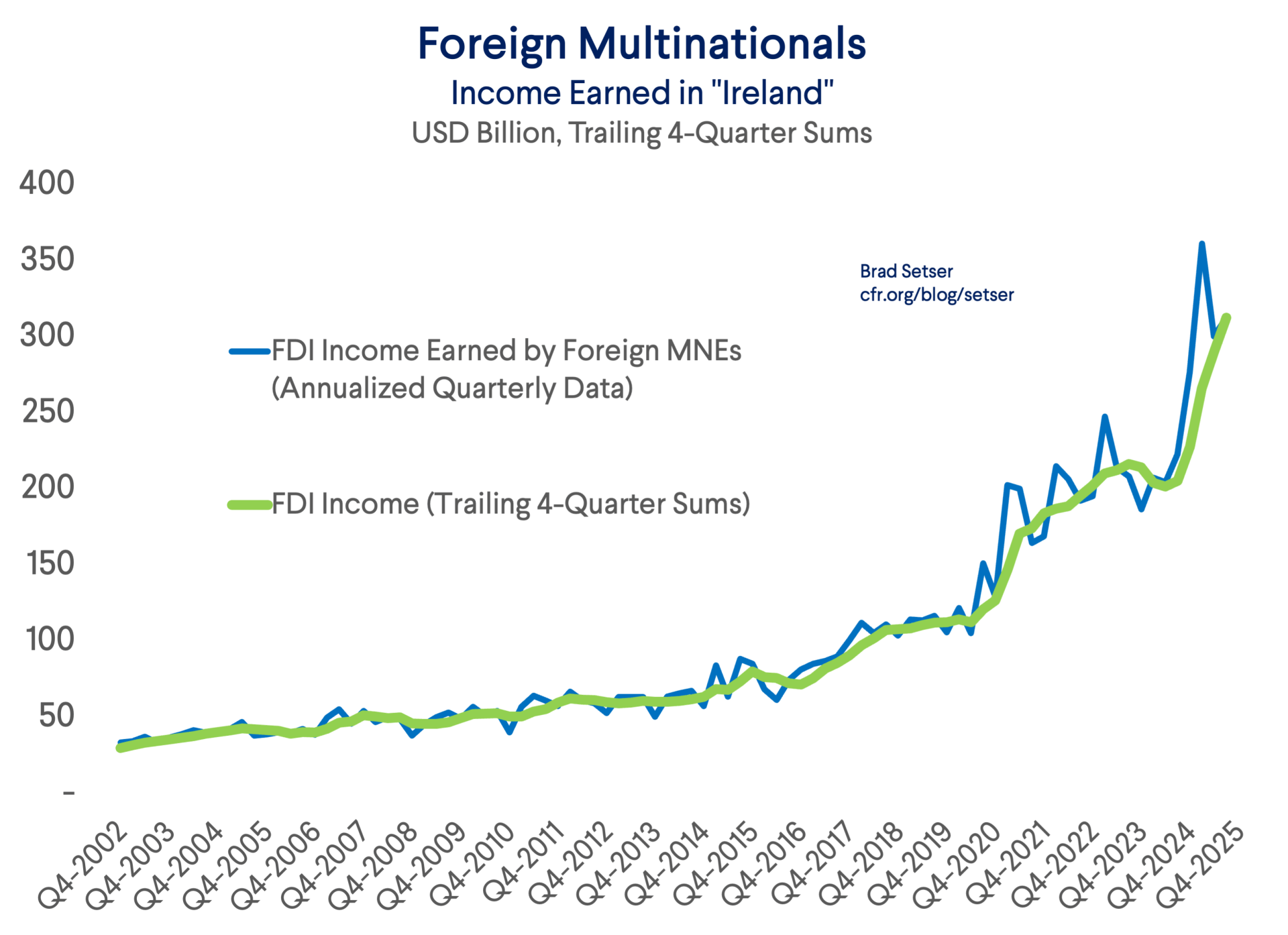
"The net result has been, well, a steady rise in the profit the world’s multinationals report in Ireland, and a steady march up in Ireland’s corporate tax take. The Irish balance of payments data now shows that foreign multinationals (almost all American-headquartered multinationals) report earnings over $300 billion in Ireland—a remarkable sum."
'The Luck of the Irish' or 'When will the music stop'? Brad W. Setser
[ Email: finfacts1@gmail.com ]
