Monday, July 30, 2007

Bank of Ireland's Wealth of the Nation Report 2007: Tough Times in Japan - the Wealthiest Nation on Earth

Katsuaki Watanabe, President, Toyota Motor Corporation

Bank of Ireland Private Banking published its annual Wealth of the Nation Report today which shows that Ireland is second only to Japan in the league of the wealthiest nations on earth.

For those who would in this grim summer of rain, cast a jaundiced eye on the glad tidings of an increase of 10% in the number of Irish millionaires (excluding principal private residence), consider the lot of the wealthiest nation - Japan.

Japan's national statistics office reported on March 2nd that inflation was zero in January, signalling the struggle to end a decade of deflation.

Core consumer prices, which exclude fresh food, were unchanged from a year earlier, the statistics bureau said.

Earnings fell the most in more than two years, according to a separate report, signalling the difficulties that the Bank of Japan has in raising its key interest rate from the lowest in the world at 0.5%.Wages fell 1.4% in January, the biggest fall since June 2004, the Labour Ministry said.

A recent Japanese Cabinet Office survey showed that people felt a high level of anxiety about their daily lives, the highest angst level recorded since the poll began nearly 40 years ago despite a recovery in the economy.

Japan's economy has grown for 60 consecutive months, the longest period of growth in the post-war era. While unemployment has fallen from 5.4% in 2002 to 4.1% at the end of 2006, wages have not moved. Statistics published by the Ministry of Health, Labour and Welfare show that the average Japanese made $2,881 a month in 2002. For most of 2006, the average monthly wage was only $2,749.

Japanese companies have kept wages in check in part by shifting more work to part-time employees, who now constitute over 33% of Japan's workforce, up from 20% in 1992.

The corporate sector has had the longest run of quarterly profit increases in 36 years, according to the Ministry of Finance. Earnings from operations rose over 12% in the financial year ending March 31, 2007, according to Nomura Research Institute, basing its estimate on the Nomura 400 index of the nation's largest companies.

Companies have not paid much heed to the pleas of Prime Minister Shinzo Abe to pass on more of their profits in wages. Instead, they are investing in new factories and upgrading equipment after a decade-long economic stagnation that followed the bursting of the bubble economy of the late 1980s.

Toyota raised its wages last March by a monthly average of €6.

IMPACT ON CONSUMER SPENDING - CAR SALES FALL TO 29-YEAR LOW

The squeeze on earnings is having an impact on consumer spending which accounts for about half the Japanese economy.

Toyota overtook General Motors as the world's biggest car maker in the first quarter of 2007 but it's home market is more than in the doldrums.

Toyota sales boost came from overseas markets in particular North America as Japan posted the lowest car sales in the twelve months to March 2007, since 1977.

Japan's vehicle sales fell for a 21st consecutive month, led by Nissan Motor and Toyota Motor.

Sales of cars, trucks and buses, excluding minicars, fell 12.6 percent to 487,738 vehicles in March from a year earlier, the Japan Automobile Dealers Association said in early April. Nissan's sales fell 16%, while Toyota's dropped 12%.

The wealthiest nation but some fun place to be for many layers in the economic pyramid!

Tuesday, July 24, 2007

Top Fund Manager Pours Scorn on the Grab-all Superearners at the top of the US Economic Pyramid

Source: PIMCO Bonds

An FT/Harris poll published on Monday shows that popular backlash against globalisation and the leaders of the world's largest companies is sweeping all rich countries.

Large majorities of people in the US and across Europe want higher taxation for the rich to counter a widespread belief that rewards are unjustified.

Supporting the view that globalisation is an overwhelmingly negative force, citizens of rich countries are looking to government to cushion the blows they perceive have come from the
liberalisation of their economies to trade with emerging countries.

US chief executive officers are regarded as unethical and overpaid, according to most Americans surveyed in a Bloomberg/LA Times poll in June.

More than six in 10 people surveyed say CEOs are ``not too ethical'' or ``not ethical at all,'' versus 33% who call them ``mostly ethical.''

An overwhelming majority, more than eight in 10, say executives are paid too much. At the same time, Americans remain upbeat about the state of the economy.

Bloomberg News says that lingering antagonism toward the boardroom set could mean that Democrats, who have been leery of being labeled anti- business in the past, may be emboldened in efforts to curb executive compensation and tighten financial regulation.

The House of Representatives in April approved a measure to give shareholders more say on how top executives are paid. A similar bill is working its way through the Senate.

Bill Gross, who runs one of the largest specialty fixed income managers in the world, with more than $687 billion in assets under management and has been termed "the nation's most prominent bond investor" by the New York Times, lets rip in his August newsletter about hedge fund and equity fund managers who currently pay a 15% tax rate on most of their income because fees are treated as capital and not income.

Gross writes: What pretense to assert, as did Kenneth Griffin, recipient last year of more than $1 billion in compensation as manager of the Citadel Investment Group, that "the (current) income distribution has to stand. If the tax became too high, as a matter of principle I would not be working this hard." Right. In the same breath he tells, Louis Uchitelle of The New York Times that the get-rich crowd "soon discover that wealth is not a particularly satisfying outcome." The team at Citadel, he claims, "loves the problems they work on and the challenges inherent to their business."

Oh what a delicate/tangled web we weave sir. Far better to admit, as has Warren Buffett, that the tax rates of the wealthiest Americans average nearly 15% while those of their salaried and therefore less incented assistants just outside their offices are nearly twice that. Far better to recognize, as does Chart 1, that only twice before during the last century has such a high percentage of national income (5%) gone to the top .01% of American families.

So when is enough, enough? Bill Gross asks.

"Now is the time, long overdue in fact, to admit that for the rich, for the mega-rich of this country, that enough is never enough, and it is therefore incumbent upon government to rectify today's imbalances," he says.

US superearners take lion's share of productivity gains

Top 25 hedge fund earners raked in more than $14 billion in fees in 2006 - equivalent to the GDP of Jordan or Uruguay

Saturday, July 21, 2007

Forty Years on from San Francisco's Summer of Love and Challenge to Conventional Prejudice in UK

Forty years ago, it was the Summer of Love in San Francisco and the anthem of the hippie generation San Francisco (Be Sure to Wear Flowers in Your Hair), which had been released in May 1967 for the famous Monterey Pop Festival that was held a month later, was making waves.

John Phillips of The Mamas and the Papas is reported to have taken 20 minutes to write the following lyrics for the song, that was sung by fellow-group member Scott McKenzie.

" If you're going to San Francisco,
be sure to wear some flowers in your hair...
If you're going to San Francisco,
Summertime will be a love-in there."

Every revolution has its positives and negatives and the verdict on this one must be overwhelmingly positive.

What should be considered is that the difference between now and the pre-1960's is that most sexual activity today is consensual. We also know from life in Ireland and elsewhere that many societies then, were more grim organised hypocrisies than they are today.

Scott McKenzie singing San Francisco at the Monterey Pop Festival 1967

The sixties were also marked by challenges to long-held prejudices and this month marks the fortieth anniversary of the legalisation of gay sex in Britain. It took us Irish another twenty-seven years to make that advance.

In Harper Lee's To Kill a Mocking Bird, which was published in 1962, lawyer Atticus Finch says to his daughter Scout: If you just learn a single trick, Scout, you'll get along a lot better with all kinds of folks. You never really understand a person until you consider things from his point of view... Until you climb inside of his skin and walk around in it.

American writer James Baldwin (1924-1987) left racist White America for France in the late 1940's and returned in 1957 as the civil rights movement was gaining strength. He took an active part in it but he was a victim of another prejudice that did not have colour boundaries.

Baldwin was both black and gay and reaction both within and outside the civil rights movement to his books Giovanni's Room (1956) and Another Country (1962) drew criticism.

He was rejected as a speaker at the renowned civil rights march in Washington D.C. in 1963 when Martin Luther King delivered his I have a dream speech.

In 1968, Eldridge Cleaver, then a member of the Black Panther Party, asserted that the novel Another Country, illustrated Baldwin's ''agonizing, total hatred of blacks.''

Baldwin had neither chose the colour of his skin or sexuality but not everyone was given to taking Atticus Finch's advice.

This week is the fortieth anniversary of the reform that legalised gay sex - in private between consenting adults over 21. Sue Cameron wrote in the Financial Times last week that before then gay people were often the victims of authority at its worst - narrow, oppressive and vindictive.

Tory Lord Hailsham, later lord chancellor, likened gay sex to heroin addiction and in the 1950s the then home secretary, Sir David Maxwell Fyfe, promised to rid England of homosexuality entirely.

"You might as well try to get rid of the common cold," was the response of film star Rex Harrison, who was Maxwell Fyfe's brother-in-law. Yet that did not stop the establishment trying and the fifties was a grim decade for gays.

Alan Turing (1912-1954), the brilliant scientist, who was chiefly responsible for breaking the German Enigma code during the Second World War, an achievement that helped save Britain from defeat in the dark days of 1941, was convicted in 1952 of acts of gross indecency after admitting to a sexual relationship with a man in Manchester.

Dr. Turing was placed on probation and required to undergo hormone therapy. He died after eating an apple laced with cyanide in 1954.

Turing is today credited with creating the blueprint for the modern computer.

In the 1965 essay, The American Dream and the American Negro, James Baldwin wrote that as a child, "It comes as a great shock to see Gary Cooper killing off the Indians and, although you are rooting for Gary Cooper, that the Indians are you."

Four decades on, in some parts of the world at least, while far from dead, prejudice is in retreat.

Irish writer Colm Tóibín's 2001 essay: The Henry James of Harlem: James Baldwin's struggles

Time Magazine Cover - - May 17, 1963: Read the Cover Story

Tuesday, July 17, 2007

Profile in Courage: John McCain

In 1954-55 John Fitzgerald Kennedy a freshman US Senator from Massachusetts, wrote a book profiling eight of his historical Senatorial colleagues, such men as John Quincy Adams, Sam Houston, and Robert A. Taft. Instead of focusing on their storied careers, John F. Kennedy chose to illustrate their acts of integrity, when they stood alone against tremendous political and social pressure for what they felt was right.

The profiled senators crossed party lines and/or defied the public opinion of their constituents to do what they felt was right and suffered severe criticism and losses in popularity because of their actions.

The book, which was published in early 1956 and won a coveted Pulitzer Prize, was claimed to have been written when Kennedy was laid low by back trouble, but it has been suggested that it was largely written by Kennedy aide Theodore Sorenson.

More important than who was responsible for writing the book, is the claim that Kennedy used his back trouble to avoid voting in the 1954 censure motion in respect of fellow Irish-American Senator Joseph McCarthy, who was admired for his stand against "communists," by Kennedy's father Joseph. McCarthy was the godfather of the first child of JFK's brother, Robert Kennedy.

As Kennedy proved himself, brave senators who preceded him and succeeded him are scarce.

One of the latter is Senator John McCain.

List of senators profiled in Profiles in Courage from Wikipedia:
It is a rare politician who doesn't bend with the wind and the more common feature is the individual who erases what were accepted by the public as passionately held positions to achieve power. Irish Green Party leader John Gormley is an excellent illustration of this.

More often than not, the brave politician pays a big price for honesty and courage.
Senator John McCain's campaign for the US Presidency is imploding.

McCain has strongly criticised the Bush Administration's execution of the war in Iraq and as a past victim of torture, has also lambasted the tacit support of the Administration for torture of prisoners.

His son has joined the armed services as he did.

It would have been easier to join those who are calling for an early withdrawal from Iraq because of political expediency rather than principle.

As a recent Financial Times editorial noted: Sadly, the finest men do not always make the most successful politicians.

Senator Joseph Raymond McCarthy: The Implosion of an Irish American Demagogue

The Rise and Fall of an Irish-American Bully

Monday, July 16, 2007

Housing Affordability - The Contrast between Britain and Germany

Britain's new Prime Minister Gordon Brown last week promised that 3m more homes would be built in the UK by 2020. ­Surplus public-sector land would be used for house-building, local councils would be given greater freedom, and incentives, to encourage building and planning rules would be streamlined, all while protecting “greenbelt” land.

Germany builds about 350,000 houses annually compared with the UK's output of 160,000-190,000 and houses are much more affordable.

There were 93,000 housing units built in Ireland in 2006.

In Switzerland where there is a high degree of decentralisation and cantons have significant tax raising powers, real house prices haven't increased since 1970!

Traditionally, it has suited Labour controlled city councils to keep population in the large UK urban areas while the Tories have restricted building in the countryside.

On this week's BBC Politics Show...

Some of us feel a quiet satisfaction in knowing that, on paper at least, the roof over our heads is making us rich.

The extraordinary rise in house prices over the last few years has made millionaires of some quite ordinary families. And anybody who invested in bricks and mortar some time ago can afford to feel smug. But what about our children?

In our heart of hearts, most of us aren't really comfortable with the idea that young people starting out in life, with good but not specially well-paid jobs, have little chance of placing a foot on the bottom rung of the housing ladder. It means people have to commute further, live in overcrowded accommodation, put strain on families and harm the labour market flexibility.

Failing foundations?

Most experts say the real reason for the upward pressure on house prices is the simple economics of supply and demand. Family breakdown, longer life expectancy and immigration contribute to 230,000 new households being formed in England alone every year. But we're only building around 160,000 new homes.

Too many people chasing too few houses equals price rises. Why can't we get this right? Other countries have rising populations, but most of our European neighbours seem to manage to match housing supply to demand. Why can they solve the problem, when we can't? Paola Buonadonna reports from Germany.
BBC Politics Show - Housing Contrasts: Germany and Britain

Sunday, July 15, 2007

Planet John Gormley and Hypocrisy

John Gormley, Minister for the Environment, Heritage and Local Government

John Gormley, the new Minister for the Environment is either disingenuous or actually believes that Green Party members are already disillusioned by the decision to drink the soup from the Early Bird Menu and go into government by jettisoning many key recent positions.

Gormley wrote in his blog on Friday, July 13th: I had hoped to use this weekend to canvass for the leadership. Unfortunately, I’ve discovered that many members have voted already. In most cases they have voted for Patricia thinking that I had it in the bag. It’s called safe seat syndrome and I know all about it from the General Election. Unless I can get those who have not bothered to vote yet to vote for me, Patricia will be Green Party leader on Tuesday next.

In the Sunday Tribune, Diarmuid Doyle writes in an analysis of John Gormley's Planet Bertie address to the Green Party's annual convention last February and says in relation to Gormley's self-projection in the media since becoming a minister: why would anybody want to present people with constant reminders of how much you had sold out in order to be just another political patsy on the plains of Planet Bertie?

It's hardly surprising that cynicism about politicians is so rife.

I understand that politics and governance is often an issue of compromise. But in Gormely's Planet Bertie address, it's not really about policy issues but values.

This was the man who lambasted Michael McDowell for not holding Bertie Ahern to account and whatever can be said about McDowell, the word hypocrite does not come to mind.

Based on John Gormley's own words, he is possibly the greatest hypocrite in Irish politics:

On Planet Bertie you can sign blank cheques because everyone does it, apparently. On Planet Bertie you can spend the average industrial wage on make-up. On Planet Bertie you can get loans from people that you don't have to pay back. On Planet Bertie you can save €50,000, without a bank account. And on Planet Bertie, climate change doesn't exist. All that stuff is made up by Trevor Sargent.

On Planet Bertie there's a strange cult called Fianna Fáil, a type of religion without vision or values; and every year in August they go on their annual pilgrimage to one of their sacred sites, the tent at the Galway races, where they pay homage to their gods and the gods bestow them with gifts for doing their bidding.

Oh yes, it's a strange place Planet Bertie. So strange and so alien to our sensibilities, that it's a planet that we Greens would like to avoid. For let there be no doubt, we want Fianna Fáil and the PDs out of Government.

The Green Party wants high standards in high places; not because we are particularly virtuous, but because strong ethical standards improve the quality of our democracy. We do it because we recognise that there are now three Governments in this country: the permanent Government, which is the civil service; the present Government, if you can call it that, consisting of the PDs and Fianna Fáil; and the real Government which are the gods in the Ballybrit tent. These people have inordinate influence on how our country is governed.

The gods will be back at the fund-raising Fianna Fáil tent at the Galway Races in Ballbrit from July 30th.

But in reality we won't be guaranteeing anything unless we're in government. We want to be in government. We see ourselves as a party of government but, we are also an unusual Party in that we are a Party of conviction with conviction politicians.

Prospective coalition partners need to know this. If they are into power for power's sake, or if it is just about gimmicks and hype, then they should think again about knocking on our door. But if they are serious about providing a better society then they will find in the Green Party dynamic dependable people who want to provide this society with better leadership.

I cannot bear the thought of another five years in Opposition. In the early years of this Party we talked about changing the values of society, changing the mindset. We talked about the need for a paradigm shift and sometimes when I look across at the Government benches I ask myself a deeply disturbing question. How would Dick Roche and Martin Cullen and Tom Parlon shift a paradigm? Possibly with a JCB and without planning permission.

The gombeenism has to end, my friends.

The Green Party have nominated jobs for two journalists to represent them in the Government Information Service.

It's about time that other journalists force John Gormley to say what he actually still believes and what was spoof from the start.

Conviction politics?

Saturday, July 07, 2007

When "Depression" Sounded less Frightening than "Panic" or "Crisis"

President Herbert Hoover in the Oval Office with Theodore Joslin, 1932 - US National Archives, Herbert Hoover Presidential Library and Museum, West Branch, Iowa

William Manchester (1922 – 2004), author of popular biographies on Winston Churchill and Douglas MacArthur and the controversial chronicler of President Kennedy's assassination, had his book The Glory and the Dream: A Narrative History of America 1932-1974, published in 1974.

It's an excellent read and presents a sense of the times starting with the Depression, through extensive use of contemporaneous newspaper and magazine reports, combined with sharp analysis.

Here is a sample on President Herbert Hoover:

Riffling through Hoover's papers, one sometimes has the strange feeling that the President looked upon the Depression as a public relations problem -- that he believed the nightmare would go away if only the image of American business could be polished up and set in the right light.

Faith was an end in itself; "lack of business confidence" was a cardinal sin. Hoover's first reaction to the slump which followed the Crash had been to treat it as a psychological phenomenon. He himself had chosen the word "Depression" because it sounded less frightening than "panic" or "crisis."

In December 1929 he declared that "conditions are fundamentally sound." Three months later he said the worst would be over in sixty days; at the end of May he predicted that the economy would be back to normal in the autumn; in June the market broke sharply, yet he told a delegation which called to plead for a public works project, "Gentleman, you have come sixty days too late. The Depression is over."

Already his forecasts were bring flung back to him by critics, but in his December 2, 1930, message to Congress -- a lame duck Republican Congress; the Democrats had just swept the off-year elections -- he said that "the fundamental strength of the economy is unimpaired."

At about the same time the International Apple Shippers Association, faced with a surplus of apples, decided to sell them on credit to jobless men for resale at a nickel each. Overnight there were shivering apple sellers everywhere.

Asked about them, Hoover replied, "Many people have left their jobs for the more profitable one of selling apples."

Reporters were caustic, and the President was stung. By now he was beginning to show signs of the most ominous trait of embattled Presidents; as his secretary Theodore Joslin was to note in his memoirs, Hoover was beginning to regard some criticism "as unpatriotic."

Nevertheless, he persevered, pondering new ways of waging psychological warfare. "What this country needs," he told Christopher Morley, "is a great poem." To singer Rudy Vallee, he said in the Spring of 1932, "If you can write a song that will make people forget the Depression, I will give you a medal."

Vallee did not get a medal but released a record of the song Brother, can you spare a dime? which was also recorded by Bing Crosby and became the anthem of the times.

The following is an extract from Theodore Joslin's diary, written in the dying days of the Hoover Administration, when the banking system was collapsing across the United States. :

Monday, Feb. 27, 1933

The Commercial did open this morning and although I felt unpatriotic in doing so, I drew out most of the money in my checking account and had Rowena come in and withdraw her savings account. And I told the President what I had done.

"Don't hoard it, Ted," was his only comment. "Put it in another bank that is safe. I would suggest the Riggs. It is the most liquid."

But I am "hoarding" temporarily. No bank is really liquid today and won't be until this panic is over. The daily hoarding figures from the Treasury are ghastly. That of yesterday was $165,000,000 bring the total to in excess of $2,200,000,000.

I had a conference with Charles Scribner this noon and may be able to arrange for the publication of a book on the last four years. The President inquired most anxiously as to all the details of our conversation and expressed the hope we could reach an agreement. "I shall think you could give Scribner's a good book," he remarked. "I hope it will work out."

The final entry for the diary is March 3, 1933, the day before Franklin D. Roosevelt was sworn into office. The final line quotes the President (described by Joslin as “angry and depressed,” ) saying “'We are at the end of our string.’”

On Sunday March 5, 1933, a day after his inauguration, President Roosevelt began the first full day of his dramatic inaugural 100 Days, by issuing an order closing every bank in the country for four days.

Harry Truman who became President on the death of FDR in April 1945, said that it's a recession when your neighbour loses his job; it's a depression when you lose yours!

Monday, July 02, 2007

Justin Timberlake, Paris Hilton and Maurice Hilleman

Dr. Maurice Hilleman (1919-2005)
Singer Justin Timberlake was in Dublin last week-end and attracted big crowds for two concerts.

I had heard of the said gentlemen because my daughter used be a fan of Britney Spears when the latter touted her virginity and love of God as badges of honour or good marketing for the impressionable teens.

Timberlake had a liaison with Spears at one stage and when it was over, with the God-veneration days behind her, she dismissed Timberlake by raising the small finger of her right hand in the air. The once proud virgin had taken to her new role with some seriousness.

Timberlake is in Europe with his "FutureLoveSexSounds" tour. In the Swedish city of Gothenburg, he treated his adoring fans with contempt but it didn't affect his pulling appeal in Dublin and they weren't all star-struck teens.

When in Gothenburg, a little girl asked if she could take a picture of him, he replied with a sarcastic grin, if she wanted him to juggle as well. Needless to say, he refused the little girl.

Then, when he returned to the hotel, there was a group of teenage fans waiting for him. Timberlake refused to be photographed. One Swedish boy rightly called him a "fuckface". The American singer responded: "Go fuck yourself!"

Back in his room, the 26-year-old rushed to the balcony of his hotel room and accompanied by a woman, used the high vantage point to throw everything but the kitchen sink down at them. He dumped strawberries and cherries and emptied plastic bottles filled with water. Then he is reported to have spat down on his fans.

The fans in Gothenburg may have been little more than impressionable children but there is no shortage of idiot adults in modern society who would find their lives pretty empty if they weren't groupies of one celebrity or other.

Many of the targets of the veneration, have nothing of substance to their credit.
In Hollywood, the leading practitioners of the genre, grab as much as the most reviled capitalist but when the star is fading, there is nothing more sought after than to be appointed to be a UNICEF Humanitarian Ambassador.

Celebrity has replaced religion for many people, even while the factors that have always sustained religions will always exist. In times past in Europe, when life was "nasty, brutish and short," people were sustained on the hope of a better life to come. In advanced consumer societies like the US, the death of community is drawing people to mega-churches where they can share an experience with others searching for something other than the inanities of trash television and a celebrity culture that worships people who parrot lines written by others while for example the name of American Maurice Hilleman, a man credited with saving more lives than any other scientist in the past century, means nothing.

Hilleman died in 2005 and during his work life, developed some 40 vaccines, among them for measles, hepatitis A and B, chickenpox, meningitis and pneumonia. He developed the one-shot vaccine that can prevent several diseases, such as MMR (measles, mumps and rubella).

Some of Hilleman's vaccine's are still used today.

It's a bimbo like Paris Hilton rather than people like Maurice Hilleman get the attention and the mainstream media like RTE, the Irish public broadcasting service and the BBC join the media circus in fear of losing an audience.

So due credit to anchor Mika Brzezinski on MSNBC last week when she objected to the news being led by Paris Hilton's release from prison.

Mika Emilie Leonia Brzezinski refused to anchor a Paris Hilton news report. Brezinski, is co-host of MSNBC's morning program Morning Joe. Her fellow anchors played the roles of jerks, on the show.

Saturday, June 30, 2007

Apple's iPod: Capturing Value in a Global Innovation System

Trade statistics can mislead as much as inform - For every $300 iPod sold in the US, the politically volatile US trade deficit with China increased by about $150 (the factory cost). Yet, the value added to the product through assembly in China is probably a few dollars at most.

US company Apple created the iPod music player and outsources the entire manufacture of the device to a number of Asian companies.

In a fascinating study published this month, researchers at the University of California, Irvine - Greg Linden, Kenneth L. Kraemer and Jason Dedrick - present a framework for analysis and use that framework to look at one member of Apple’s iPod family, part of a thriving ecosystem that has upended business models across the consumer electronics, computer, and entertainment industries.

The researchers say that the iPod is a perfect example of a globally innovated product, combining technologies from the US, Japan and a number of Asian countries.

Using a report from Portelligent Inc. that provided a breakdown of all the 451 parts that go into the 30-gigabyte video iPod, which retails in the US for $299, the Irvine researchers costed the components and the final assembly at plants in China.

The most expensive item was the hard drive, which was manufactured by Toshiba and costs about $73. The next most costly components were the display module (about $20), the video/multimedia processor chip ($8) and the controller chip ($5). They estimated that the final assembly cost only about $4 a unit.

Tracing the supply chain geography by attributing the cost of each component to the country of origin of its maker was viewed as presenting a partial picture because Toshiba makes its hard drives in the Philippines and China. The Broadcom chips are made by an American company but most of them are manufactured in Taiwan.

To distribute the costs of the iPod components across the countries where they are manufactured, the researchers looked at the production process as a sequence of steps, each possibly performed by a different company operating in a different country.

At each step, inputs like computer chips and a bare circuit board are converted into outputs like an assembled circuit board. The difference between the cost of the inputs and the value of the outputs is the “value added” at that step, which can then be attributed to the country where that value was added.

The researchers estimated that the $73 Toshiba hard drive in the iPod contains about $54 in parts and labour, meaning that the additional value that Toshiba added to the hard drive was $19 plus its own direct labour costs. This $19 is attributed to Japan since Toshiba is a Japanese company.

An estimated $163 of the iPod’s $299 retail value in the United States was captured by American companies and workers, breaking it down to $75 for distribution and retail costs, $80 to Apple, and $8 to various domestic component makers. Japan contributed about $26 to the value added (mainly via the Toshiba disk drive), while Korea contributed less than $1.

The unaccounted-for parts and labour costs involved in making the iPod came to about $110. The authors hope to assign those costs to the appropriate countries, but that’s not so easy to do.

Conclusion

The researchers set out the following conclusions from their initial analysis:

First, the biggest winner is Apple, an American company, with predominantly American employees and stockholders who reap the benefits. If the iPod had been made by Sony or Samsung, the value to the US would be considerably less.

Second, the producers of high value, critical components capture a large share of the value. For the 30GB Video iPod, the highest value components are the hard drive and the display, both supplied by Japanese companies. US suppliers provide the two most valuable microchips.

Third, trade statistics can mislead as much as inform. For every $300 iPod sold in the US, the politically volatile US trade deficit with China increased by about $150 (the factory cost). Yet, the value added to the product through assembly in China is probably a few dollars at most.

While Apple’s share of value capture is high for the industry, the iPod’s overall pattern of value capture is fairly representative.

Today, no single country is the source of all innovation and therefore US companies need to work with international partners to bring new products to market. These companies will capture profits commensurate with the extra value they bring to the table.

This is simply a fact of business in the 21st century, and the good news is that many American companies are winning this game and continuing to bring significant benefits to the US economy.

The researchers conclude that as long as the US market remains dynamic, with innovative firms and risk-taking entrepreneurs, global innovation should continue to create value for American investors and well-paid jobs for knowledge workers.

But if those companies get complacent or lose focus, there are plenty of foreign competitors ready to take their places. If this happens, the benefits from the global innovation system could quickly shift away from the US.

100 Million iPods Sold

Apple announced in April 2007 that the 100 millionth iPod has been sold, making the iPod the fastest selling music player in history. The first iPod was sold five and a half years ago, in November 2001, and since then Apple has introduced more than 10 new iPod models, including five generations of iPod, two generations of iPod mini, two generations of iPod nano and two generations of iPod shuffle. Along with iTunes and the iTunes online music store, the iPod has transformed how tens of millions of music lovers acquire, manage and listen to their music.

Apple launches the iPhone - Report and Video

Wednesday, June 27, 2007

The baddies "talking-down" the Irish economy

Export Performance and Competitiveness of the Irish Economy Central Bank of Ireland Quarterly Bulletin 3 2005 - - - It is foreign-owned firms that are driving Irish exports and most of them don't have or need a marketing function in Ireland. The trend of exports from Irish-owned firms is represented by the line at the bottom of the chart and is almost flatlining.

Should this concern us at all?

It's becoming common to lambaste referred to "commentators" for "talking-down" the Irish economy even though the legitimate issues that are being highlighted are seldom contested.

There is often a confusion between the short-term and the medium to longer-term. The European Central Bank is for example not raising interest rates to impact inflation in 2007 but its focus is on medium term price stability in particular.

Trends in economic development generally take long gestation periods and cannot be easily reversed. The very significant 1989 decision of chip giant Intel to locate a major manufacturing facility in Ireland, followed by Dell Computer in 1990 and Hewlett-Packard in 1995, happened because of the successful evolution of the US presence over a number of decades and the development of a network of local suppliers.

The State's inward direct investment promotion agency IDA Ireland says in its Annual Report for 2006 today that it is confident in our ability to win important new investments this year and beyond.

Others highlight the strong Irish economy that is the "envy" of the world but the focus is on the here and now.

I have highlighted in recent times, issues that should concern us now in relation to outcomes, in ten or more years' time.

Economic development does not neatly fit into an election cycle. Do issues such as the miniscule investment that goes into Irish business compared with overseas commercial property matter? Post the residential and construction boom, if we project employment in the sector at 180,000 down from 282,000 today and 126,100 in early 1998, should it concern us? Are we fooling ourselves by claiming multinational exports to China as an Irish success?

In the export sector, should we be doing much better in what the Bank of International Settlements termed, a Golden Age of growth?

Some of these and other issues are covered here:

Irish Economy: No crash in sight nor credible strategy to maintain export-led growth in long term; Overseas commercial property to remain investment of choice

Greencore's Irish operations become property play at time when Irish food industry is faltering

IBEC says new Government must address Ireland’s economic challenges; Goods exports grew over 250% in 1995-2001 - Expanded only 6% in 2002-2006

IBEC, the principal Irish business representative body is guilty of high treason by focusing on some inconvenient truths!

Just consider the Ministry of Information type scenario if all economic commentary was the preserve of estate agents and bank economists!

We've had two examples from critcs in business, in recent days.

In the 12 months that SSIAs accounts matured with a value of about €16 billion, it should not be a great surprise that a survey of 1,000 people that was taken in the weeks after the highest level of maturities this year, found that 62% said that they are financially secure.

Michael Leahy, chief executive of Standard Life Ireland, said on Monday: "The relatively high score in the new Standard Life Financial Confidence index of 62 may well surprise those who have been talking down the Irish economy over the last number of months. There is a strong underlying confidence out there that would appear more robust than certain commentators are giving credit for."

In the Sunday Business Post, PR man Paul Allen wrote that nothing makes news like bad news, and the Irish media is full of it at present.

Let’s look at the facts. We have a growing population, full employment, strong job creation, rising household income, a high savings ratio, together with strong retail sales and industrial production.

Ok, we are not achieving the jaw-dropping growth levels of previous years, but in international terms, Ireland is still in an economically envied position.

But turn on RTE, read the papers, tune into radio broadcasts and you’d swear we were heading straight for recession.

One of the country’s leading economists, Dan McLaughlin of Bank of Ireland, rightly slammed negative reports of our current economic situation.

He has suggested that certain elements in the media are trying to talk us into a recession and do not give a true picture of how the economy is performing. He suggested misleading headlines were taking things out of context.

It is the media’s obsession with spinning negative news that potentially will have a more negative longer-term impact on our fortunes.

We owe a great deal to our international neighbours for our economic success. Direct foreign investment was – and continues to be – a vital element in our growth.

But as our neighbours look in from afar at our performance, the question is – are they being misled by our media? As we constantly question our own economic future, so do they.

Any assumptions about our impending future should be based on sound fact, rather than a vociferous media pack intent on spinning headlines of doom and gloom.

It is time the media got back on track and started acting like an independent observer and reporter on our current fortunes, rather than spinning the stories to suit its own bad news agenda.

So Michael Leahy refers to strong underlying confidence while Paul Allen wants some cheerleading for our current fortunes.

The people they criticise generally have longer term horizons.

Tuesday, June 26, 2007

Irish Public Sector pay for Clerical Employees trumps counterparts in top Multinationals in Ireland

The ESB plant at Lough Ree, County Longford.

According to the CSO*, the pay levels of Clerical, Managerial and Industrial staff in the "Electricity, gas, steam and hot water supply" category which includes Bord Gais and the ESB, are substantially above other categories of workers.

The average pay of clerical employees (non-managerial) in Dec 2006 was €49,370 compared with €40,350 in "Manufacture of chemicals, chemical products and man-made fibres," which is dominated by multinationals such as Pfizer, Eli Lilly, Glaxo, Merck and others - a 22% pay gap.

The comparison between these two sectors is largely on payroll costs as large private sector companies generally provide pension coverage but the benefits would not compare with the public sector.

In other sectors, the disparity in benefits is much wider where there is no pension coverage.

So, arguments that ESB pay is high only because of the skills slant of the workforce, are not sustainable.

*Links to current release dated 29032007

JUNE 2006: Electricity prices for Irish industry are third highest in EU and sixth highest for consumers; Irish household prices are 46% higher than UK

Sunday, June 24, 2007

Minister Martin's delusional "Asia Strategy"

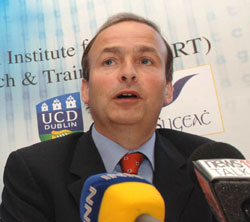
Micheál Martin TD, Minister for Enterprise, Trade & Employment

Minister for Enterprise, Trade and Employment, Michéal Martin on Tuesday last expressed satisfaction with the latest trade statistics.

Martin said that he was particularly pleased to note the strong export performance in a number of our markets in the first quarter of 2007 compared to the same period last year. Exports to China and Hong Kong were up by 37% and to the Philippines by 88%.

The Minister said "this strong performance in this region reflects our ongoing efforts to promote and grow our markets through our Asia Strategy."

He did not refer to the fall in exports to Malaysia by 31%. Besides, exports to India increased by €3.9 million to €37 million in the quarter- not a great gaisce in respect of the region's second economic powerhouse.

Then again, it's no big deal because the so-called Asia Strategy is either a manifestation of Minister Martin's delusions or an artful example of spin that even IBEC, the main Irish business representative organisation, has fallen for.

Earlier in June, Martin said in an address to a conference on China, at University College Cork, provided a vivid example of the conflation of the performance of multinationals in Ireland with the small indigenous sector.

Martin said: "Ireland’s knowledge –based economy, built on innovation and technology, is substantially shaped by the emergence of strong technology-led and export-focused Irish companies. Companies, which have become world leaders in their respective industries."

The danger in the yarn that the Minister is spinning is that rather than face reality, some people may well buy this "Asia Strategy."

The export performance that he is bragging about relates to decisions that are made by the likes of Intel, Microsoft and Pfizer - supply decisions that generally are not made in Ireland.

There is no reference to the small number of Irish-owned firms that are exporting to Asia and for that matter to all regions outside of the UK.

So with the "Asia Strategy" going well, maybe we need similar strategies elsewhere. Wwhy did exports to Italy fall by 15% and to France by 7%.

We should be careful what we wish for, because perish the thought, the Minister might add a line to the blank job specs of one of his junior ministers and hey presto, we will get a "Europe Strategy."

Irish Economy: No crash in sight nor credible strategy to maintain export-led growth in long term; Overseas commercial property to remain investment of choice

Thursday, June 21, 2007

Ryanair's Michael O'Leary seeking to boost business amidst market slowdown but gets puck in eye on customer service

Ryanair Chief Executive Michael O'Leary said on Tuesday that the low-cost airlines average ticket prices will be lower this year and predicted a ``big downturn'' for the industry.

Ryanair cut prices on 3 million seats at a cost of as much as £45 million pounds over three months, O'Leary said today at a press conference in London.

``We expect a big downturn in the next 12 months, we just don't know what's going to cause it,'' O'Leary said, noting the cyclical nature of the industry. ``We must be due one.''

Ryanair wants to take market share from EasyJet Plc and meet targets for passenger growth by forcing prices lower. It is targeting to boost customer numbers by 22 percent this year even as it pays more for fuel. The company confirmed that profit will climb about 5 percent in its 2008 financial year as it slashes prices.

However, Michael O'Leary ran into flak on customer service from a recent customer, who happened to be a former editor of the Financial Times.

The following letters were recently published in the FT.

Albania's airport terminal is run more efficiently

by Michael O'Leary

Published: June 15 2007 03:00 Last updated: June 15 2007 03:00

From Mr Michael O'Leary.

Sir, Philip Stephens ("Put an end to the Heathrow misery", June 12) correctly describes the passenger experience at Heathrow as a nightmare. Sadly it is no better at the other BAA monopoly airports at Gatwick and Stansted.

These appalling and badly run facilities are further depressing proof of the abject failure of the Civil Avation Authority's regulatory regime in the UK. Any system that rewards a monopoly by setting its income as a fixed percentage of its capital expenditure is bound to incentivise that monopoly to waste not millions, but billions, on capital expenditure in order to inflate its future income.

Mr Stephens also correctly identifies the solution. Competition. The only way the London airports can be improved is for the Competition Commission to force the break-up of BAA's London airport monopoly. Spin out Heathrow, Gatwick and Stansted into three separately owned companies and force them to compete vigorously against each other. Competition will deliver more efficient investment, passenger-friendly terminal facilities, lower costs and improved services. Put an end to the regulatory scandal that allows the BAA monopoly at Stansted to contemplate wasting £4bn on a second runway and terminal, when these facilities can and should be built for less than a quarter of that sum.

The BAA airport monopoly has not delivered for passengers. Albania provides more efficient terminal facilities than the BAA monopoly. Ryanair welcomes Mr Stephens' support for our campaign to break up this overspending, overcharging airport monopoly.

Michael O'Leary,
Chief Executive,
Ryanair

O'Leary's protest is not without irony
By Andrew Gowers

Published: June 18 2007 03:00 Last updated: June 18 2007 03:00

From Mr Andrew Gowers.

Sir, While endorsing Michael O'Leary's sentiments about the horrors of BAA's "monopoly airports" (Letters, June 15), am I alone in finding such criticism somewhat hypocritical coming from the head of an airline with as cavalier an attitude to its own customers as Ryanair frequently displays?

A recent encounter by my family with Mr O'Leary's "On-time airline" casts an ironic light on his protests against the poor passenger experience at Heathrow, Gatwick and Stansted. Ryanair was supposed to fly us to Treviso for Venice, but our plane was diverted by a storm and we landed at Trieste.

Then the fun started. The airport was closed and bleary-eyed police and customs officers had to be summoned from their homes to deal with us. Contrary to pre-landing assurances from the crew, there was no transport, accommodation or refreshments for the arriving refugees. More entertainingly still, once we were ensconced out of sight in the airport building, the Ryanair crew simply disappeared, never to be seen again. Thus 184 passengers including elderly, infirm and infants, were left to fend for themselves in the middle of nowhere through the small hours of the morning.

According to the Air Transport Users Council, airlines have a contractual duty to get passengers to the destination they paid for at no extra cost. Can anybody explain why an airline that so flagrantly and insouciantly violates its obligations to customers should continue to have a licence to fly?

Andrew Gowers,
London SE21

Tuesday, June 19, 2007

Ireland needs 3 more Government Ministers than France

President Nicolas Sarkozy at the commemoration on Monday, June 18, 2007 of the war-time call by General Charles De Gaulle from London for the French to resist the Nazi occupation.

French President Sarkozy reshuffled his slimmed down cabinet of 15 today and added 17 junior ministers (including a woman of Senegalese origin and the outspoken head of a group that advocates for Muslim women).

Ireland with a population of 4.2 million compared with France's 61 million, is going to have 3 additional junior ministers according to Taoiseach Bertie Ahern, bringing the total to 20.

Most of them will be non-entities outside of their constituencies. A government with an interest in reform would surely start at the top like Sarkozy.

Staying in France, the Paris-based government think-tank, the OECD, that has 30 member countries, is working on proposals for reform of the Irish public service, which has increased by 77,000 people since 1997.

There is little chance of any of the proposals being implemented.

Sunday, June 17, 2007

The Greens drinking the soup

Trevor Sargent

Under pressure in 1973 from the White House Press Corps, including CBS News' Dan Rather, as the Watergate scandal engulfed the Nixon Administration, Press Secretary Ron Ziegler retracted previous statements that were proved to be false by saying: "This is the operative statement. The others are inoperative."

It's not news that politicians would like to have past statements declared inoperative.

Green Party leader Trevor Sargent said to Taoiseach Bertie Ahern in the Dáil in October 2006: "You have lost moral authority... Do the decent thing and resign."

Eight months later with more unanswered questions having arisen about Ahern's byzantine financial arrangements in respect of the renting and subsequent purchase of his house in the 1990's, it was Sargent who resigned and then seconded the nomination of Ahern as Taoiseach in the new Dáil.

The late Ron Ziegler had said on the tangled web of Watergate: "If my answers sound confusing, I think they are confusing because the questions are confusing and the situation is confusing."

Confusing is the word indeed.

During the General Election campaign, there were only two parties that directly raised the issue of Ahern's explanations about his finances - the Green Party and the Progressive Democrats. They are both now in Government even though the issue of a possible lodgement of $45,000 that was made at the Mahon Tribunal on May 28th - 4 days after the General Election, remains to be clarified.

Sargent resigned as leader of the Greens because he had said that he would not go into a government with Fianna Fáil but he will be a Junior Minister in the new Fianna Fáil-led administration!

Taoiseach Bertie Ahern has also disclosed that he plans to increase the number of Junior Ministers to 20, to facilitate the addition of Trevor Sargent while allowing Ahern himself greater leeway with political patronage.

At best, there is a case for 5-6 Junior Ministers but adding 3 to the 17 that were mainly occupied by non-entities in the last Dáil, is at least consistent in the unreformed public sector.

Section 11 of the Green Party Manifesto:

"[The Green Party] will reduce the number of Government Ministers from 15 to 12 and reduce proportionally the Ministers of State."

Labour Party leader Pat Rabbitte said in the Dáil this week that the word ‘review’ appeared in the programme for government 56 times, the word ‘examine’ appeared 23 times and the term ‘consider’ made 14 appearances.

The Irish Government has spent up to €400 million on management consultants since 1997. So there's more scope for the industry in the years ahead.

Bertie Ahern operates more as chairman than CEO and other than the Northern Ireland peace process, does not take an active role in pushing issues like for example the way Tony Blair operates.

The Green Party should look at the very limited impact that the Progressive Democrats (PDs) had in government over a decade.

When the PDs were proposing that Dublin Port be relocated to North County Dublin, agreement could not be reached for years on providing a modern airport service in Dublin.

When Trevor Sargent referred to the 1973 Kenny Report on development land as one of the key issues for the Green Party, he was being more an optimist than realist.

Time will surely show how much.

Tuesday, June 12, 2007

Golden Fleece: Ballsbridge, Property Shakedowns, Nimbies, Developers and Selfless Politicians

The decision of members of Dublin County Council to reject a local area plan for Ballsbridge, Dublin 4, that provided for the building of high-rise buildings of up to 20 storeys, has been presented as a success against a developer-dictated plan that was drawn up by the executive of the Council.

Much of the power of councillors was taken away from them almost a century ago to reduce corruption. The main power that was left was in respect of rezoning land.

In recent decades, because of the big jump in the value of development land compared with its agricultural value, land has become the crack cocaine addiction for Irish politicians.

It's not that land is scarce in Ireland, it's just that there is an artificial scarcity created and what property obsessed Irishman would want to contemplate living in a sinkhole like Switzerland, where the real cost of residential property, hasn't increased since 1970!

The Celts came from the area of modern Switzerland and contrary to what we would like to believe, they never bothered to visit or invade Ireland.

We can't blame the Celts for our contemporary obsession with property, but attributing it to the English landlord system of feudalism that operated in Ireland until the 1880's, is also off the mark. When farmers near Irish towns become multimillionaires through making bonanzas from development, they have no qualms about becoming landlords.

A planning corruption tribunal has been sitting since late 1997 and it has effectively been operating in a parallel universe. After almost a decade of revelations of politicians for hire, ZERO has been done to change the existing system.

Taoiseach Bertie Ahern has said that any changes in the existing system may conflict with the Constitution.

It's absolute rubbish and as with the story that up to €4.6bn of the €18.5bn of taxpayers' money that will be spent on new main roads over the next decade will go into the pockets of landowners, nothing is done about it.

Fred Barry, chief executive of the National Roads Authority is reported as saying that the increases in the cost of land for major roads projects as "disturbing". Land acquisition accounts for 23% of the cost of roads projects in Ireland, but just 12% in England, 10% in Denmark, 9.4% in Greece and 1% in Iceland. A further 2% of the €18.5bn provided in the Government's Transport 21 for road building over the next decade will go to archaeologists.

Six years ago, Taoiseach Bertie Ahern asked the Committee on the Constitution to examine the issue of the pricing of development land. In 2004, it concluded that Mr Justice Kenny's recommendation in 1973 that development land should be priced with a 25% mark-up on agricultural land prices, could be introduced by legislation, and without amending the Constitution.

So, after almost ten years of stories of endemic corruption and what changes have been made in the system that spawned it? ABSOLUTELY NOTHING!

The cost of the tribunal is an issue but as usual with politicians who lack the appetite to challenge vested interests, the most pertinent issue is conveniently ignored.Are there journalists who can connect the dots rather than be led up the garden path?

Stamp duty is an easier topic to sell to the masses rather than the Golden Fleece from land.

...and we've had a system of free education since 1968!

Our planning system has moved on from brown envelopes but anyone who believes that corruption has ended, is a fool.

Besides inducements for politicians, there are the shakedowns that are involved in so many developments.

There is seldom any Irish development without a shakedown and it is often a residents' association that is seeking some payoff - maybe a wall to be built or some other amenity - that the local authority hasn't bothered providing.

There are Nimbies (Not in My Back Yard) everywhere, whether it is in Mayo in respect of the Corrib gas field or in Dublin's most expensive thoroughfare - Shrewsbury Road, Dublin 4.

The default impression that developers had, that hotels, pubs or other amenities could be knocked and the sites rezoned, was overdue a slapdown.

However, the reaction of councillors to the local area plan for Ballsbridge, more likely relates to the power of wealthy Nimbies than a new dawn for Irish planning.

Developer Sean Dunne's Mountbrook Homes which paid €379 million for the Jurys, Jurys Tower and Berkeley Court hotel sites, is one of a number of developers who have been seeking zoning changes. Another developer, Ray Grehan of Glenkerrin Homes, paid €171.5m for the former UCD Veterinary College site, which is adjacent to the Berkeley Hotel site. Other developers with holdings in the area include Bernard McNamara, who owns Carrisbrook House on the corner of Northumberland Road.

After pre-planning discussions with the developers, the council decided to recommend the inclusion of mixed-use local centre buildings with a height of up to 12 storeys and district centre buildings with a height of up to 20 storeys. Retail elements would have been restricted to 10,000 sq m.

Assistant city manager Michael Stubbs is reported to have said that it could be a year before the matter is revisited, as the council's next priority was to advance area plans for Phibsboro and then Rathmines.

Both Sean Dunne and Ray Grehan purchased their Ballsbridge sites in 2005 when the European Central Bank's key interest rate was 2% by the time a compromise is reached in 2008, never mind planning approval granted, the ECB rate may well be 5%.

Dublin has become an urban sprawl because of an over-reaction to the experience of a high-rise multi-block public housing that was built in Ballymun in North Dublin in the 1960's.

What is very interesting about the Ballsbridge development that it is not only about a developer seeking to change zoning classification for his hotel sites, which are currently solely residential, but Dunne is also one of the prominent Nimbies in Ballsbridge!

Earlier this year, a High Court judge was reported to have accused millionaire developer Sean Dunne of making a ‘‘spurious’’ complaint about a proposed development near his Dublin 4 home.

Dunne and solicitor Stephen MacKenzie were seeking a judicial review of An Bord Pleanala’s decision to grant planning permission for a three-storey block of seven apartments and underground car park, in Shrewsbury Road.

The development by O’Malley Construction involved demolishing the buildings on the site of the former Chester Beatty Library. The two men complained that An Bord Pleanala had failed to give reasons for its decision, particularly considering the unique character of Shrewsbury Road, which had been designated a residential conservation area.

An Bord Pleanala’s documentation on the issue, refers to Dunne as "Third Third Party Sean Dunne":

Previous decision: The appellant refers to An Bord Pleanala’s recent refusal of permission for development on the site. He states that there has been no change in policy in the meanwhile which would warrant a different decision on the current application which it is contended differs in minor respect only.

This appeal raises similar issues to the Mc Evaddy and Mc Kenzie appeals in relation to zoning, density, height, bulk, scale, precedent and procedure (defective public notice).

Traffic, parking, and traffic hazard issues are also raised.

So the Irish planning system is a minefield of Nimbies and politicians seeking shakedowns and developers who can be both innocent and guilty parties in the ramshackle system.

RELATED

Whitaker's Ireland and the planned destruction of two of Dublin's premier hotels

Ballsbridge Nimbies Hit the Jackpot from Lansdowne Stadium Development

Sunday, June 10, 2007

Waning of China Effect will result in Higher Inflation and Interest Rates

In October 2006, the world's biggest container ship, the Emma Maersk, owned by A.P. Moeller Maersk of Denamrk, docked for the first time in the UK port of Felixtowe loaded with nearly 45,000 tons of Chinese-made goods including MP3 players, computers, Christmas trees and crackers.

The Emma Maersk, which is 400 metres long (1,300 ft), 56 metres wide and 60 metres tall, and dubbed the SS Santa, unloaded more than 3,000 containers for supermarkets and stores before heading to mainland Europe.


While migrants have kept labour costs down, in recent years, the falling price of goods that are imported from Asia, led by China, have contributed to the fall of inflation in the Developed World.

The fall in goods prices and impact in inflation in the Developed World, is known as the China Effect.

Prices of clothing and footwear sold in Ireland have fallen by 36% since 1996. Household appliances are down by about 25%; toys are 30% cheaper, and of course, in the audio-visual category, products are on average now 56% cheaper than they were in 1996.

The latest report on Irish consumer price inflation shows that in May, service inflation rose by 9.15 while the price of goods fell by 0.3%.

A 2005 study by Dresdner Kleinwort Wasserstein reckons that China has knocked almost a full percentage-point off America's inflation rate in recent years. The recent 2% revaluation of the yuan will probably be absorbed by Chinese manufacturers trimming their profit margins and so will not be passed on into export prices. But Americans calling for a 25-30% revaluation may come to regret it: the result would almost certainly be faster inflation.

China's reduction of inflationary pressures has allowed central banks to hold interest rates lower than they otherwise would be. Three and a half years into its recovery, America's real short-term interest rates were only 0.7%, almost two percentage-points below their average at the equivalent stage in previous recoveries since 1960.

The question now is how long will the China Effect last and keep interest rates in Europe and the US lower than they would be if goods inflation was higher?

An article in the New York Times on Friday, June 8th, says that the recent rise in China’s pork prices signals an end to cheap output.

The NYT says that business executives say that with wages rising 10% or more a year in many Chinese cities, the country’s days are numbered as the world’s lowest-cost producer of many cheap labor-intensive products, like toys and shoes.

Last autumn, Governor of the Bank of England Mervyn King said in a speech:

Over the past decade the integration of China, India and other emerging markets in Asia into the world trading system has lowered the prices of clothes, electrical goods and other items that we import from them. The terms on which we trade with the rest of the world improved. That provided a boost to real disposable incomes and so to consumer spending. But the rapid growth of China and India also meant sharp increases in the prices of many commodities, such as copper, aluminium, iron ore and, particularly important, oil.

In that sense the rises in oil prices over the past two years are very different from the oil price “shocks” of the 1970s. They reflect rapid growth in the demand for oil – faster than the growth of capacity – rather than an OPEC-inspired contraction of supply. What we have seen is not so much an “oil shock” but a consequence of the rise of China.

The lower prices for many consumer goods and the higher cost of oil are both the result of globalisation. Having benefited from the former we are now experiencing the latter. As a result, our import prices are no longer falling as rapidly as they were, and, indeed, over the past year even the prices of non-oil imports have risen. With the additional impact of higher oil prices, real disposable incomes are rising more slowly, and the long awaited rebalancing of the economy away from consumer spending to business investment and net exports is underway.

“People tend to underestimate the deflationary impact over the last 10 years” from Chinese exports, said Michael R. P. Smith, the chief executive of HSBC’s Asian operations told the New York Times. “It has got to the limit: you’ve had wage inflation, you’ve got rising natural resource prices. There’s just no more give.”

The message is that interest rates may have to be increased to a higher rate for a more sustained period, if the positive impact of falling prices of imports from Asia wanes.

Wednesday, June 06, 2007

Irish Corporate Tax Regime and Synthetic Indignation

Peer Steinbrück, Germany's Finance Minister

Luxembourg vetoed attempts on Tuesday to end its position as a low-tax haven for web retailers, blocking VAT reforms that were proposed by the German presidency of the European Union and supported by all other member states.

Jean-Claude Juncker, Luxembourg's Prime Minister and Finance Minister who is known as Mr. Euro because of his longtime chairmanship of the Eurogroup of Eurozone Finance Ministers, refused to give up a tax regime that has attracted companies including Skype, AOL, Apple and Ebay to the Grand Duchy, providing his government up to €300m ($406m, £204m) a year in revenues.

Luxembourg's 15 per cent VAT rate is the lowest in the EU

"I can't agree here today," Juncker said despite criticism from other EU member states, which are losing jobs and tax revenues because of the shift offshore of the booming e-commerce sector.
Peer Steinbrück, Germany's Finance Minister, secured agreement on other aspects of a package of VAT reforms and believes Juncker will lift his veto by the end of the year.

At Tuesday's meeting Peer Steinbrück accused Ireland of subsidising its public services with EU funding while engaging in unfair tax competition.

In a strong public attack on Irish corporate tax policy, Steinbrück said States such as Ireland risked jeopardising the EU idea if they continued in this manner. "It is unfair to reduce tax rates and get money from the EU to finance public spending.

"Ireland is offering tax rates [ that are] very advantageous and organising this tax competition,"
Steinbrück said at the meeting of EU finance ministers. "Some countries are concerned about using certain techniques to fund their public finance requirement in the hope that if they do not have sufficient income it will be compensated by EU funds," he said

The German criticism followed a discussion on a proposal to harmonise the EU corporate tax base ( as distinct from tax rates).

The Irish Government fears that harmonising the base will inevitably lead to a harmonisation of the corporate tax rate.

Jamie Smyth of the Irish Times says that Steinbrück cited the tax reliefs available in the "Dublin Docklands" - commonly known as the International Financial Services Centre - as an example of using low tax rates to attract industry and engage in tax dumping. He also cited tax relief schemes in the Netherlands as examples of unfair tax competition that were undermining co-operation in the EU.

"There is a clear interest in Europe in certain countries to make their tax attractive to influence where they [ multinationals] locate and it is not a diplomatic disgrace to say it," added Steinbrück, who also said that young people in Germany were asking him to ask these questions of other EU states.

Steinbrück also said Ireland had nothing to fear from the corporate tax base harmonisation proposal.

Ireland's corporation tax rate is 12.5%. Rates are above 20% in most EU countries.

Irish business employers' group IBEC strongly criticised Steinbrück's comments, calling them "disgraceful, and unbecoming of a president in office of the Ecofin council".

Unbecoming indeed!

This could surely be termed synthetic indignation.

We have been very lucky that the funding members of the European Union, principally Germany gave us about €36 billion in aid with few strings attached.

We were simply lucky that they were stupid.

The IBEC gun-for-hire would surely be as indignant if the boot was on the other foot!

Company Taxation/Common Consolidated Corporate Tax Base: European Commission presents progress report before finalising its proposal due in 2008

Thursday, May 31, 2007

John Waters as Rip Van Winkle

Either the people or the media should resign, John Waters, who makes a handy living from his weekly column in the Irish Times, wrote last Monday.

It's not clear if Waters himself considered resigning but like most in the money economy, he may need to fumble in a greasy till and take the shilling, however tainted it may be to him.

Waters wrote: The easier solution is for the media, with the exception of Eoghan Harris and myself, to stand down en masse, it having been established that, once again, ideological agendas, wishful thinking and spite have prevented them doing their jobs. If there is a better reason for resigning, I cannot think of it.

Once again it has been made clear that the Irish media are covering a different country, a country of some leftist or pseudo-ethical ideal which the Irish people stubbornly decline to give birth to.

To understand what was going to happen in this election you had only to stand back and ask: is the Opposition convincing enough to remove a Government which has presided over the most prosperous period in Irish history and seemed not to have blown it?

You had merely to understand how people felt about where we stood, as opposed to what they claimed to think or what they ought to be thinking.

It may well take ten years when the construction sector returns to a level similar to other advanced countries and the foreign firm dominant export sector shows that it has overcome an uncompetitive induced decline, to really test Waters' caveat: and seemed not to have blown it.

We will then know whether it has mattered that no significant reforms have been put in place to prepare for less comfortable economic times.

Remember the factoid - 92% of Irish exports were made by foreign owned firms in 2006.

It's also well to remember when the vast growth in China and India is promoted as an excellent opportunity, most of our exports there, are not by Irish firms and marketing decisions on what is exported there, are not made in Ireland.

Waters concluded his column: For decades, Irish newspapers, including this one, have engaged in stern lecturing of the Irish people on account of their primitive cultures and lack of moral fibre, and the Irish people have repeatedly given them the two fingers.

Now, perhaps, the media might condescend to look at what the Irish people are saying about themselves, and what this means. They might also reflect on the notion that, without roots in society, no value system has any value.

Politics is what is, not what journalists want.

Expecting to dance to the tune Arise and follow Charlie, John Waters as Rip Van Winkle, wakes up to an Ireland where divorce is legalised, homosexuality decriminalised and the cap is no longer doffed to the high and mighty in Church and State. God forbid, the media at last even dares cast a cold eye on the machinations of politicians.

In a seminar titled Society? Church? It's a question of Education, Waters said: And this, it seems to me, is at the core of the problem that we face now in this society. That we have created this idea in Irish society, that because we’re on the run, as I was at the age of twenty, twenty one, from the alleged or believed assertive authoritarianism of the Catholic Church, that we could run for miles and be free, without consequences.

And that somehow it didn’t matter that we could create a society without the core represented by Catholicism up to that point and that it wouldn’t be missed, that somehow, organically in the society, there would come a new flowering of belief and that people would either believe in the Buddha or believe in Allah or whatever and that the rest of us would simply sit around tolerating them And it seems to me, now, that this a completely unsustainable idea.

It was exactly the attitude of the cure being worse than the disease, that has destroyed the moral authority of the Catholic Church for some Irish people in recent decades.

The old world of spurious certainty, was to shield the hypocrisies in what was a republic of fear for anyone who did not kowtow to the status quo. Some people lived happy lives but it was woe betide for anyone else.

Waters' comment - Irish people have repeatedly given them the two fingers - reeks of arrogance and is simply wrong.

The people he excludes may well be in a minority but they are still Irish people.

It is minorities that usually sow the seeds of change that is often eventually embraced by its once fiercest critics.

Change inevitably brings with it some negative factors but the alternative cannot be a committee of do-gooders who would try to impose a social order.

Life today in Ireland is a better place than the organised hypocrisy of the past and despite the hand-wringing of people like John Waters, a pertinent fact that is worth considering is that while for example sexual mores have changed, the biggest difference between today and the past is not the extent of sex but that modern sex is mostly consensual.

At the seminar referred to above, Waters said: We have a society now in which suicide levels are among the highest in the world - again the lack of meaning - but how deep does this meaning go?

Does he really, really know what our suicide levels were, back in the good old days of authority and fear?