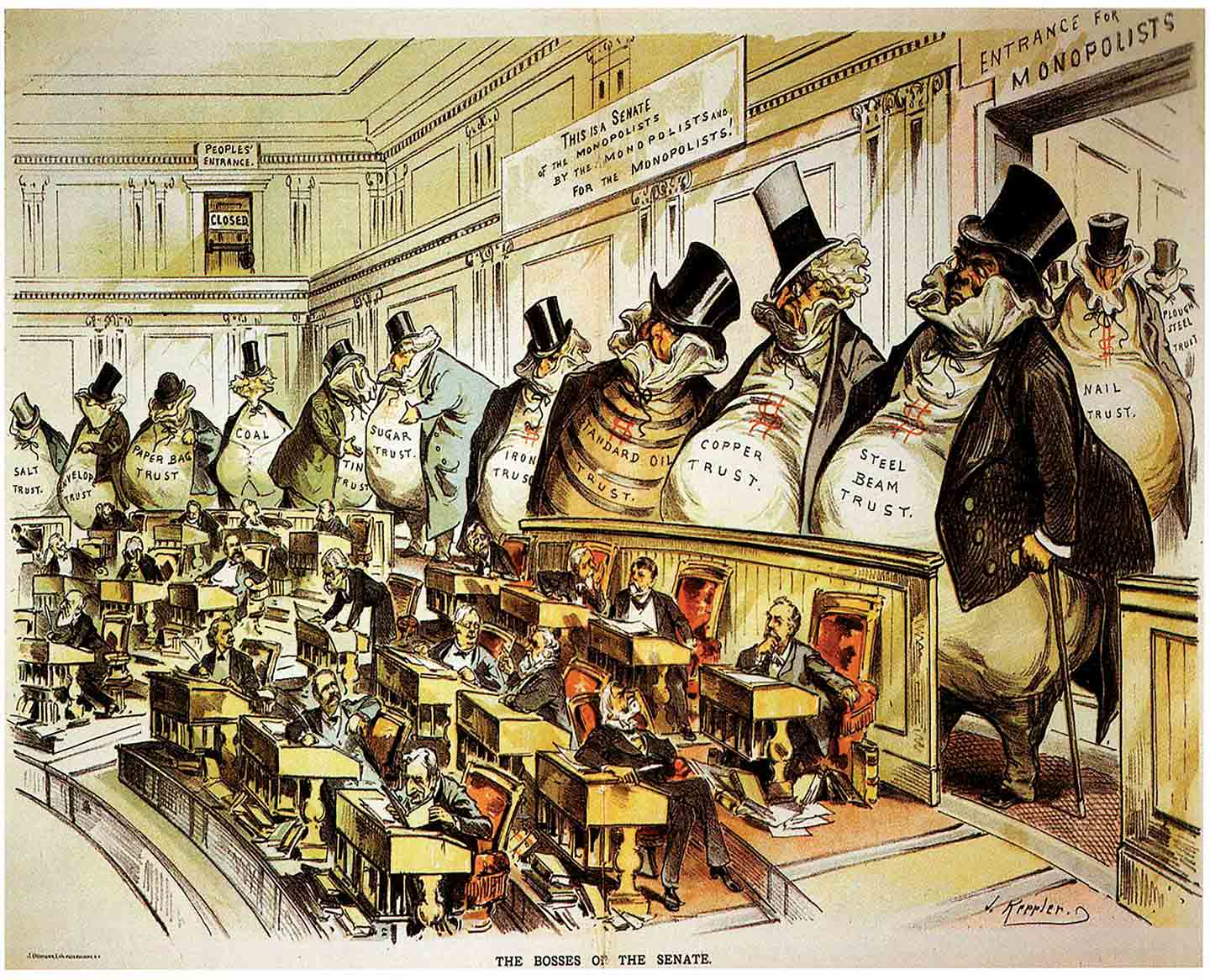
‘'The Gilded Age: A Tale of Today' was a satirical novel written by Mark Twain and Charles Dudley Warner, which was first published in 1873. The book’s title became synonymous with graft, materialism, and corruption in American public life in the years after the end of the Civil War.
Here is the approximate percentage of total U.S. wealth held by different groups:
Top 1%: Held about 31% of the total net worth in Q2 2025.
Top 10%: Held approximately 69% to 70% of the total wealth (this includes the top 1%, the 90th-99th percentile, which holds about 36.4%, and the 50th-90th percentile, which holds 30.3% - the calculation is derived from combining data snippets for specific percentiles as the 10% figure isn't explicitly stated as a single data point in the 2025 results).
Older data from 2016 and 2022 suggest this figure has been consistently high, around 68% to 70%.
Bottom 50%: Held only about 2.5% of the total U.S. wealth in Q1 2025.

5) Pardon of January 2006 United States Capitol attack defendants, almost 1,600
There are more, including a former member of Congress.
List of people granted executive clemency in the second Trump presidency:
In his role as the 47th president of the United States (January 20, 2025 – present), Donald Trump granted executive clemency to more than 1,600 individuals as of July 23, 2025, all of whom were charged or convicted of federal criminal offences.
The wealth of the Trumps in 2025
As of late 2025, the estimated total net worth of the Trump family is approximately $10 billion, an amount that has reportedly doubled since the 2024 election.
The primary driver of this significant increase has been investments in cryptocurrency ventures.
- Donald Trump: His personal net worth is estimated to be between $5 billion and $7.3 billion, with much of the recent gains coming from cryptocurrency and his media company, Trump Media & Technology Group (TMTG).
- Jared Kushner: Now a billionaire, his net worth is estimated at $1 billion, largely due to his private equity firm, Affinity Partners, which raised significant capital from Middle East backers after he left the White House.
- Eric Trump: His wealth has increased substantially from an estimated $40 million the previous year to around $750 million, primarily through his involvement in family businesses and crypto ventures.
- Donald Trump Jr.: His net worth has risen to an estimated $500 million, up from $50 million, also fueled by the "anti-woke economy" and crypto investments.
- Barron Trump: The youngest son, at 19 years old, has an estimated net worth of $150 million, mostly from his own early involvement in cryptocurrency.
- Ivanka Trump: Her net worth is estimated at around $100 million, though she has largely distanced herself from politics and certain family business ventures.
- Melania Trump: Her net worth is estimated to be between $50 million and $70 million, derived from modelling, speaking engagements, and her own business ventures, including a meme coin.
Stephen Miller, a top adviser to President Trump, sold shares worth $50,000 to $100,000 in the mining company MP Materials following a July announcement of a lucrative deal between the Las Vegas company and the Trump administration, government filings show.
The New York Times reports that the company’s stock price rose to $45.23 on July 10, the day the deal was announced, from $30.03 per share on July 9.
The share price climbed to $76.58 on Aug. 14, the date Mr Miller sold his shares — a historic high. The stock peaked at just under $99 on Oct. 14, after the company reported earnings. It closed at $59.82 on Tuesday, December 9.
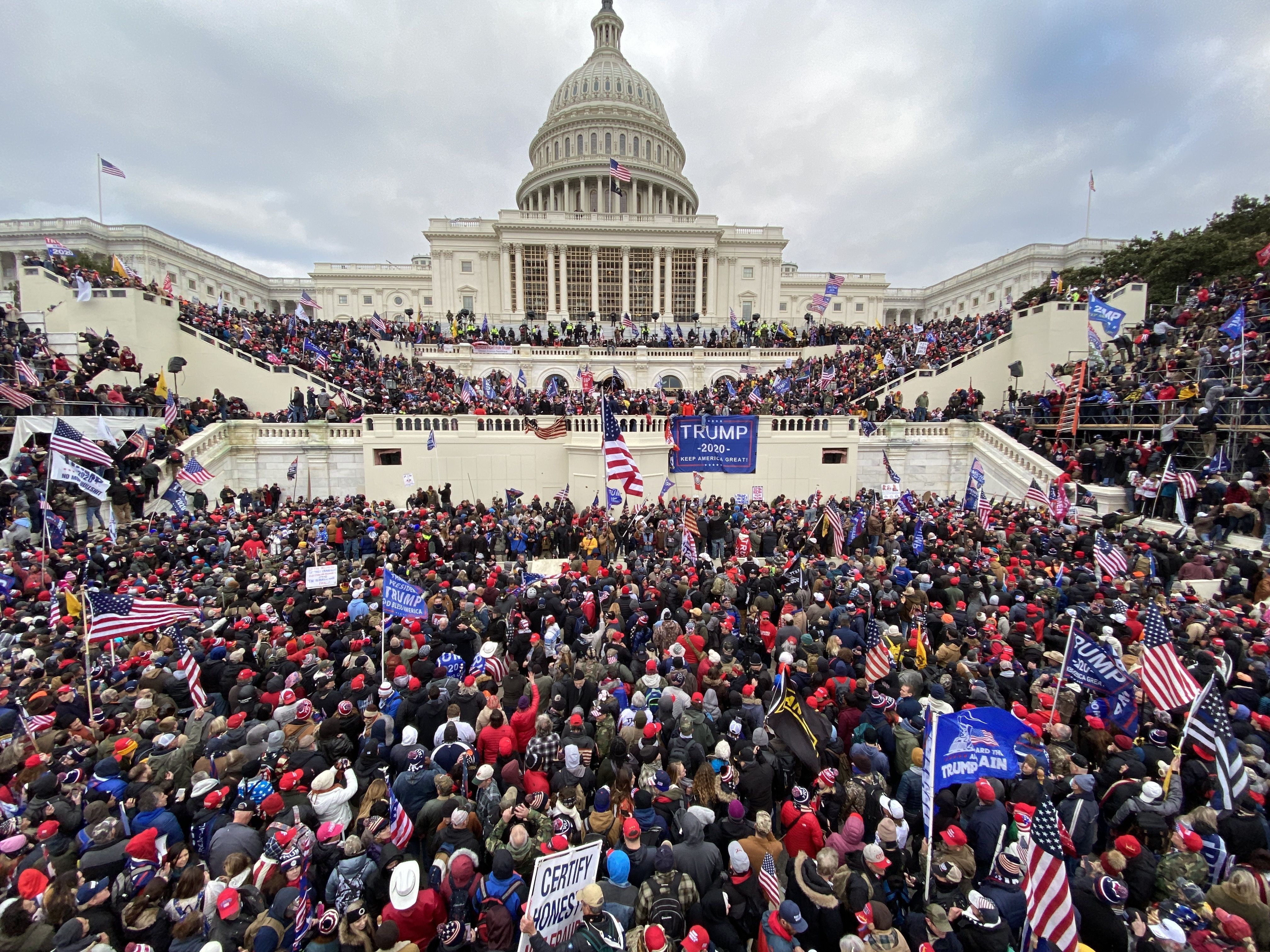
Trump files $10 billion defamation lawsuit against BBC over edited clips of his Jan. 6, 2021, speech
Donald Trump has filed a lawsuit against the BBC over its editing of a speech he made to supporters in Washington before they stormed the US Capitol in 2021, requesting up to $10bn in damages.
Dec 16, 2025: "The New York Times reported that President Trump sued the BBC for $10 billion on Monday evening over the editing in a documentary that the British broadcaster said had left the “mistaken impression” that he called for violent action before the storming of the U.S. Capitol.
In a 46-page lawsuit filed in federal court in Miami, Mr. Trump accused the BBC of defaming him and violating Florida’s Deceptive and Unfair Trade Practices Act. He demanded $5 billion for each offence."
On the same day, the barricades were breached by Trump supporters for the first time since 1814, according to congressional historians.
Trump sat in the White House, watching the rampage on TV as the mob called for the lynching of his Vice President.
Defaming him??
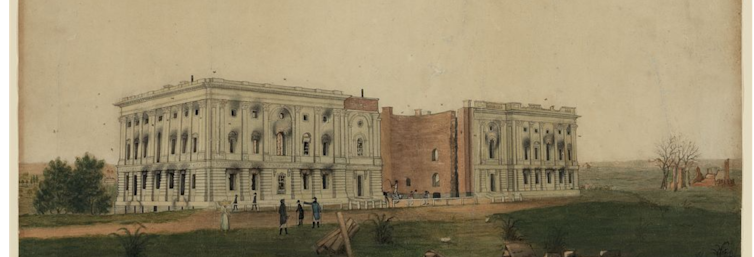
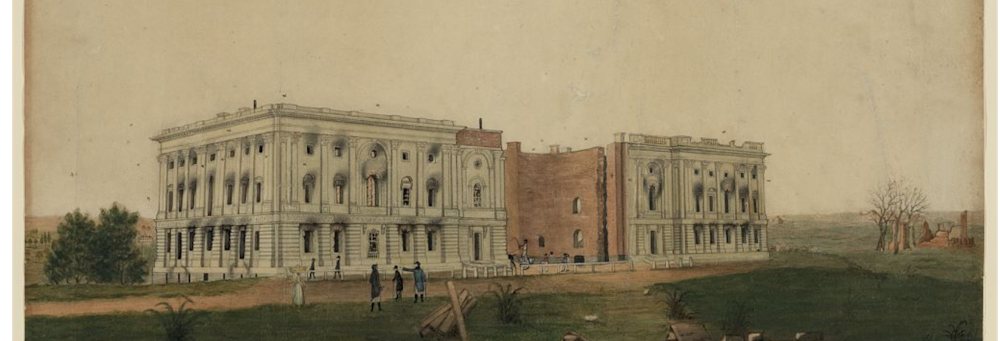
The US Capitol following British attempts to burn the building in 1814. George Munger/US Library of Congress
Richard Hofstadter (1916-1970), a renowned American historian and in his series of essays published in 1948 as 'The American Political Tradition,' Chapter VII is titled 'The Spoilsmen: an Age of Cynicism.' He wrote:
"In the years from Appomattox to the end of the nineteenth century, the American people settled half their continental domain, laid down a vast railroad system, and grew mighty in the world on their great resources in coal, metals, oil, and land. There is no other period in the nation’s history when politics seems so completely dwarfed by economic changes, none in which the life of the country rests so completely in the hands of the industrial entrepreneur.
In business and politics, the captains of industry did their work boldly, blandly, and cynically. Exploiting workers and milking farmers, bribing congressmen, buying legislatures, spying upon competitors, hiring armed guards, dynamiting property, using threats and intrigue and force, they made a mockery of the ideals of the simple gentry who imagined that the nation’s development could take place with dignity and restraint under the regime of laissez-faire."
John D. Rockefeller: "God gave me my money"
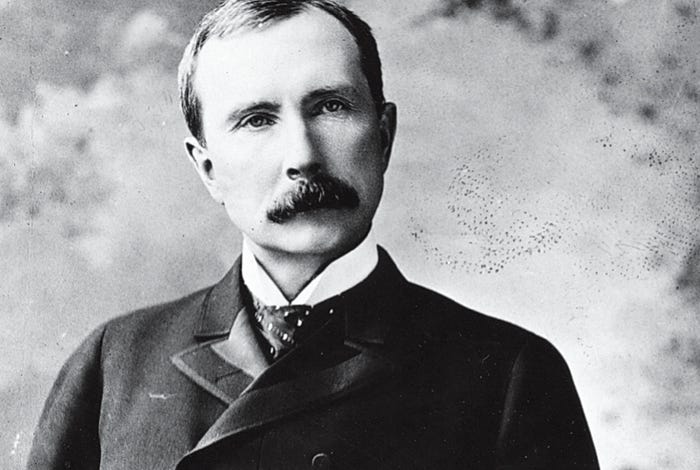
John D. Rockefeller — The World’s First Business Billionaire
John D. Rockefeller's relationship with competition was one of elimination, as he used his company, Standard Oil, to aggressively acquire or drive rivals out of business, thereby achieving a monopoly.
He viewed his approach as bringing "order and efficiency" to a chaotic market, using ruthless tactics like secret railroad rebates to cut prices and consolidate control, ultimately dominating over 90% of the U.S. oil refinery market by 1878. This led to public backlash and eventually resulted in antitrust legislation like the Sherman Antitrust Act and the Supreme Court-mandated breakup of Standard Oil in 1911.
President Theodore Roosevelt had a contentious relationship with John D. Rockefeller and his company, the Standard Oil monopoly. Roosevelt viewed Rockefeller's trust as a "bad trust" that harmed the public good and used aggressive antitrust tactics to break it up, viewing the company as an example of the corporate power he wanted to curb. While he personally "did not much like Rockefeller," Roosevelt's primary concern was the monopoly's anti-competitive practices, such as cornering the market and underpaying workers.
John D. Rockefeller was born on July 8, 1839, and died on May 23, 1937, at the age of 97.
The Irish Interest in the Gilead Age


- Forcing Relocation onto Reservations: The primary goal of the U.S. government at the time was to clear the Great Plains for white settlement and transcontinental railroad expansion.
- Sheridan's campaigns were intended to compel the Great Plains tribes to relocate to government reservations, ending their nomadic lifestyle and traditional way of life.
- Destruction of the Bison Herds: A central part of Sheridan's strategy was promoting the widespread slaughter of American bison (buffalo), the primary source of food, clothing, and shelter for the Plains Indians. By eliminating this vital resource, he aimed to destroy the Native Americans' self-sufficiency and force them to rely on government rations on the reservations.
- Perceived Efficiency and Justification: Sheridan and his superiors, like General William Tecumseh Sherman, believed that using decisive, overwhelming force, even against non-combatants, was a pragmatic way to end the conflict quickly and minimise long-term casualties for both sides. He reportedly stated, "If a village is attacked and women and children killed, the responsibility is not with the soldiers but with the people whose crimes necessitated the attack".
- Prevailing Attitudes: His actions reflected the prevailing attitudes of the era, which often viewedNative Americans as obstacles to national expansion and consolidation. The infamous quote,
- "The only good Indian is a dead Indian," is widely attributed to him (though he may have denied coining the phrase, it became associated with his reputation and policies).

"The Indian knew that life was equated with the earth and its resources, that America was a paradise, and they could not comprehend why the intruders from the East were determined to destroy all that was Indian as well as America itself. And if the readers of this book should ever chance to see the poverty, the hopelessness, and squaler of a modeern Indian reservation, they may find it possible to truly understand the reasons why."

A little more Irish women than men emigrated to the U.S. Housemaids living in the house would be usual.
Catherine Coll lived in a 3-room cottage on a half-acre of land, in Brueree, County Limerick.
She left Ireland via Queenstown in 1879 and had a child on the 14th of October 1882.
There was no record for a Vivion de Valera on the 1880 Census, and he apparently went to Denver, Colorado, as he had Tuberculosis, and he died soon after.
Catherine may have been raped, and the issue had to be hushed up.
In the 1880 Census, there is a New York entry for a Valera, but none for Vivion De Valero anywhere in the US.
Kate said she and Vivion got married in Greenville, Jersey City in September 1881, and later she said the marriage took place in New York.
"The main issue is that no civil or church marriage record for Kate Coll and Vivion de Valera has been located in the records of Catholic churches in New Jersey or New York, nor in the civil records of either state for that time period. This lack of documentation fueled rumours of their son Éamon de Valera's illegitimacy later in his life, which was a significant social stigma at the time in Catholic Ireland."
In April 1885, the young Edward arrived in Queenstown (Cobh) in Cork Harbour on the SS City of Chicago with his uncle Edward (Ned), to be reared by the Coll family in Co. Limerick.
The shameful stain of an Irish Civil War 100 years ago
Éamon de Valera (1882-1975) was a towering, complex figure in 20th-century Irish history, an American-born revolutionary, statesman, and leader of the independence movement who became Taoiseach (Prime Minister) multiple times and President of Ireland, shaping the nation's path with his staunch Irish republicanism, leadership in Fianna Fáil, and role in crafting the 1937 Constitution, though his legacy remains debated due to his stance on the Civil War and social conservatism.
Total Emigration Numbers to the U.S. (1861-1900)
The total number of emigrants from Ireland to the U.S. during this period was approximately 2,174,367, broken down by decade as follows:
"A distinguishing feature of Irish emigration was the large number of young, single women who emigrated to America. The proportion of women among Irish emigrants rose steadily after the Famine, and by the turn of the century, women were outnumbering men."
- 1861–1870: 690,845
- 1871–1880: 449,549
- 1881–1890: 626,604
- 1891–1900: 427,301
Ireland's Éamon de Valera and the taboo of illegitimacy
13th Amendment to the U.S. Constitution: Abolition of Slaverywas ratified in December 1865 and permanently ended slavery in the United States. (1865).

In the Deep South, between 1877 and the mid-1960s. Jim Crow was more than a series of rigid anti-black laws.
It was a way of life. Under Jim Crow, African Americans were relegated to the status of second-class citizens.
Jim Crow represented the legitimisation of anti-black racism. Many Christian ministers and theologians taught that white people were the Chosen people, and black people were cursed to

The term "Jim Crow" originated in the 1830s from a popular, demeaning minstrel show character, and later became the widely used shorthand name for the systemic practice and laws of racial segregation and discrimination against African Americans in the post-Civil War United States.