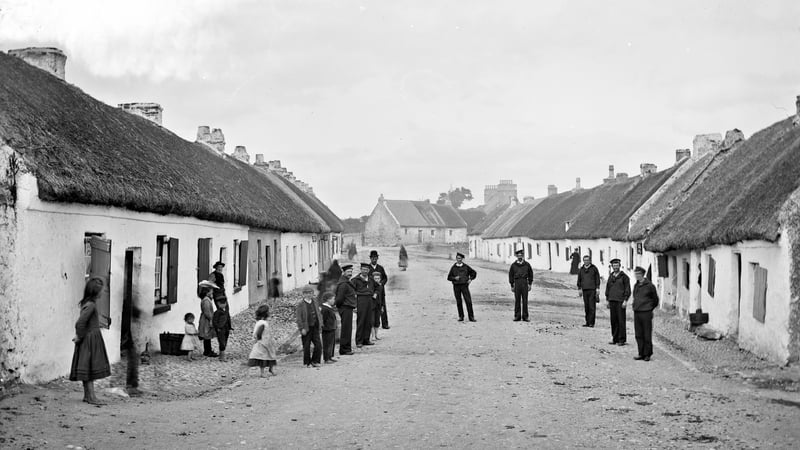
National Archives: The 1926 Census with over 700,000 individual household returns
The first Census of the Irish Free State (Saorstát Eireann)
The first census of the Irish Free State, taken on April 18, 1926, recorded a total population of 2,971,992 persons.
This figure represented a population decrease of 5.3% from the last all-Ireland census in 1911, under British rule. The data from the 1926 census provides a detailed snapshot of the newly independent nation, with statistics on various aspects of life.
The 1922 establishment of the Irish Free State marked the first significant self-rule for most of Ireland since the English conquest, following centuries of domination, culminating in defeat at Kinsale in 1601 during the Nine Years' War, which ended Gaelic Ireland's last major resistance against English rule, paving the way for English colonisation.
It was 321 bitter years of English/British rule over the Irish, spanning from the defeat at Kinsale to the establishment of the Irish Free State in 1922.
Kinsale, Ireland, became a medieval walled town in the 13th century under Anglo-Norman control, strategically built around a sheltered harbour for trade, defence, and customs collection.
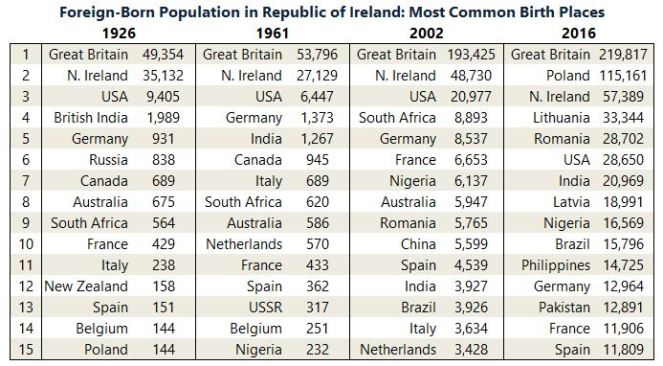
In 1926, the first Census of the Irish Free State recorded a Foreign—Born population of approximately 67,076 people, representing 2.5% of the total population.
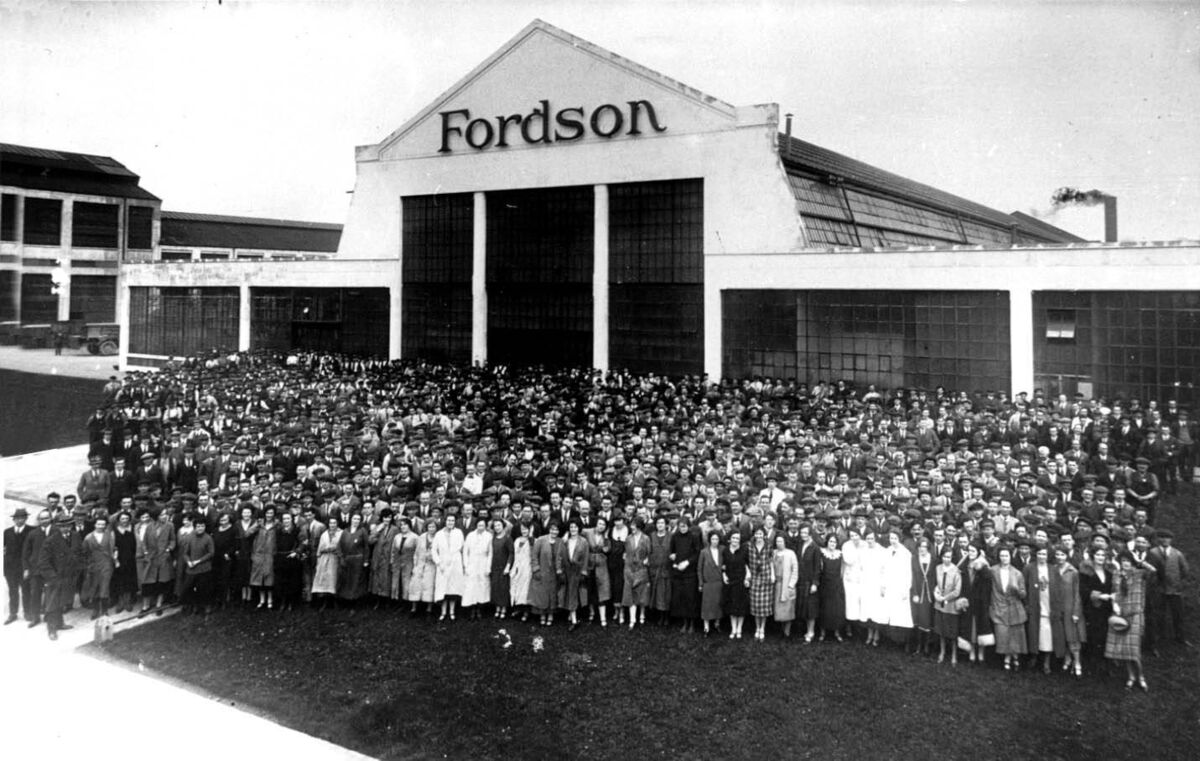 Workers outside the Ford factory in Cork in 1926.
Shannon Hydroelectric Scheme (1925–1929)
The 1926 Foreign—Born rate (2.5%) remained largely stable for decades, only reaching 5.6% by 1981 before surging to 18.5% in the 2022 Census.
The 1961 Census total was 2,818,341 — lower than the 1926 total.
Foreign—Born Population from 2.5% to 26%
The total Foreign—Born Population is estimated to have reached approximately 1.2 to 1.3 million by late 2025, accounting for roughly 26% (one in four people) of the total population.
This figure is higher than the "Non-Irish citizen" count because it includes naturalised Irish citizens who were born abroad.
Ireland's population in 2012 was approximately 4,600,132 persons.
Foreign—Born Percentage: In the 2011 Census, approximately 17% of the population was born outside the state. World Bank data for 2015 reported the Foreign—Born population at approximately 15.9%.
Total Population: The overall population reached 5,458,600 in April 2025, a 1.4% increase (78,300 people) from April 2024.
Following the 2022 Russian invasion of Ukraine, about 140,000 refugees arrived in Ireland. The number is about 80,000 now.
By October 2025, over 28,000 Ukrainian arrivals were recorded with earnings from employment, with the most common sectors being wholesale, transport, and accommodation.
Others are on a temporary basis.
The year 2010 marked the point when there were the most births — 77,000 — in one year while 2024 was the point at which the number of children being born began to decline. Births have declined steadily since 2010, to 54,000 last year.
In the 1841 Census for Ireland, before the Potato Famine, the population was 8 million to 8.5 million.
In the area that would become the Irish Free State and later the Republic of Ireland or Ireland
(26 counties) the population was 6.5 million.
So Ireland is not full yet!
In January 1963, Ireland, at last, began cutting trade tariffs.
In June of that year, the state visit of President John Fitzgerald Kennedy to his ancestral homeland was a momentous occasion for US-Irish relations.
"Most countries send out oil or iron, steel or gold, or some other crop, but Ireland has had only one export and that is its people," John Fitzgerald Kennedy said at Cork City Hall, on his presidential visit to Ireland in June 1963.
Patrick Kennedy (1823–1858), the great-grandfather of the president, left Ireland for Boston in 1848.
The 1960s were part of the "Golden Age" of economic growth and prosperity in Western Europe, a period of unprecedented expansion that transformed the continent after World War II.
This era was characterised by high economic growth, rising living standards, a burgeoning consumer culture, and significant social progress.
Ireland began attracting significant American companies to open plants in the country.
Apparently, there are 3m Irish Passports in circulation.
Total Population Abroad: The United Nations Department of Economic and Social Affairs (UN DESA) reported the stock of Irish Total Population Abroad:
The UN DESA reported that the stock of Irish—born individuals living overseas stood at 714,405 in 2024.
Top Destinations for Irish: United Kingdom — 360,446: United States — 125,844 — Australia 90,203 — Poland: 28,912, and Canada — 28,277
(The "Born in Ireland" Polish Community: This group includes thousands of children born in Ireland to Polish parents who then returned to Poland.
Between 2004 and 2022, over 300,000 Polish citizens lived in Ireland, and by 2012, one in four children born in Ireland had Irish—Born mother.)
Château de la Muette, view from the park, Paris, France
The Organisation for Economic Co-operation and Development (OECD) is widely considered a "club of the rich" because most of its 38 member countries are high-income, developed economies.
OECD countries
The Organisation for Economic Cooperation and Development (OECD) brings together 38 different countries. The majority of OECD members are prosperous, economically developed countries.
The members of the OECD are: Australia, Austria, Belgium, Canada, Chile, Colombia, Costa Rica, Czechia, Denmark, Estonia, Germany, Finland, France, Greece, Hungary, Iceland, Ireland, Israel, Italy, Japan, Latvia, Lithuania, Luxembourg, Mexico, the Netherlands, New Zealand, Norway, Poland, Portugal, Slovenia, Slovakia, South Korea, Spain, Sweden, Switzerland, Turkey, the UK and the USA.
The combined population of the 38 Organisation for Economic Co-operation and Development (OECD) member countries is approximately 1.4 billion people as of 2024.
This figure represents about 18% of the world's population. The majority of OECD members are developed, high-income economies with an average life expectancy of around 80 years.
For countries with levels above 2 million, the highest Foreign-born population – 2024 is Australia at 32.2%
Switzerland at 32.2% of the population and at 25: Evolution since 2014: +25%
Ireland at 23.3%
Research in 2025-2026 indicates that roughly 4 out of 5 children in global orphanages are not true orphans, but "paper orphans" often recruited from poor families for profit.
This has led to the emergence of an illegal market where children are kidnapped or purchased to meet the high demand from Western adopters.
"The EU addresses the issue of orphans and vulnerable children in non-EU poor countries primarily through humanitarian aid, development cooperation, and enforcing international child protection standards in its external policies. Actions focus on supporting education, healthcare, nutrition, and protecting children from violence, exploitation, and illegal adoption."
Recent revisions to the Human Trafficking Directive (enforced through 2026) now explicitly include illegal adoption as a form of exploitation, aiming to protect orphans from criminal networks.
Ireland had a rich culture before the English/British invasions
Glendalough, meaning "Valley of Two Lakes" in County Wicklow, Ireland (South of Dublin), is famous for its 6th-century monastic settlement founded by St. Kevin, becoming a major religious centre known for learning and piety with landmarks like its iconic Round Tower, churches, and St. Kevin's Bed cave.
Flourishing for centuries, it was a vital monastic city, attracting pilgrims before its eventual decline and destruction by English troops in 1398, leaving behind ruins that are now a protected National Monument.
Prince Charles (now King Charles III) visited Glendalough, Ireland, in May 2019 with Camilla, Duchess of Cornwall, as part of a royal tour, where he met local schoolchildren, National Parks & Wildlife Service (NPWS) staff, and mountain rescue teams, discussing conservation, environmental work, and receiving an oak seedling, highlighting his interest in nature and Irish heritage at the historic monastic site.