Wednesday, March 23, 2022

Putin's versions of history are myths

Joachim von Ribbentrop, Foreign Minister of Germany; Joseph Stalin, the Soviet Union supreme leader; and Vyacheslav Molotov, the Soviet Foreign Minister, at the signing of the 10-year non-aggression pact between Germany and the Soviet Union, Moscow, 23 August 1939
The Nazi-Soviet Non-Aggression Pact had a secret protocol that left Hitler free to attack Poland without risking war with the Soviet Union and it divided eastern Europe into German and Soviet spheres of influence.

Since the invasion of Ukraine, Putin, the Russian dictator, has claimed that Ukraine is “an inalienable part of our own history, culture, and spiritual space.” Belarus, Ukraine and Russia, all trace their roots back to the ancient principality of Kyivan Rus’. According to Encyclopedia Britannica "both the origin of the Kievan state and that of the name Rus, which came to be applied to it, remain matters of debate among historians. According to the traditional account presented in The Russian Primary Chronicle, it was founded by the Viking Oleg, ruler of Novgorod from about 879. In 882 he seized Smolensk and Kyiv, and the latter city, owing to its strategic location on the Dnieper River, became the capital of Kievan Rus. Extending his rule, Oleg united local Slavic and Finnish tribes, defeated the Khazars, and, in 911, arranged trade agreements with Constantinople.

Tuesday, March 08, 2022

Ukraine, George Orwell and emergence of state sovereignty

Last week, Putin, the Russian dictator, had his rubber-stamp parliament pass a law providing for sentences of up to 15 years in jail for the crime of distributing "fake news."Russia is already a dangerous place for journalists and in 1992-2022, 82 journalists have been killed there according to the Committee to Protect Journalists (CPJ): the motive has been confirmed in 58 cases.

“I want everyone to understand, and for society to understand, that we are doing this to protect our soldiers and officers, and to protect the truth,” the speaker of the Russian lower house, Vyacheslav Volodin, said.

The Orwellian move evoked George Orwell's Ministry of Truth in the 'Nineteen Eighty-Four' novel which was first published in Britain in June 1949.

“I do not believe that the kind of society I describe necessarily will arrive,” Orwell wrote, but “that something resembling it could arrive. I believe also that totalitarian ideas have taken root in the minds of intellectuals everywhere, and I have tried to draw these ideas out to their logical consequences.”

George Orwell (Eric Blair 1903-1950): “'Who controls the past,' ran the Party slogan, 'controls the future: who controls the present controls the past.'”

The main character Winston Smith introduces the theory behind the work he does at the Ministry of Truth. The Party understands that by rewriting the events of the past and controlling the narrative of history, they can maintain their position of authority.

Orwell created Newspeak, the official language of the totalitarian state of Oceania. Its purpose was to diminish the range of thought by eliminating shades of meaning and nuance from Oldspeak (Standard English). For example, without a word for freedom, the concept of freedom cannot exist.

The world was divided into three superstates — Oceania, Eastasia, and Eurasia (map from Wiki).


Putin has banned the words "war" and "invasion" from being used by the media in Russia. Big Brother has only sanctioned the “special military operation on the territory of Ukraine.”

“We don’t see any need to exacerbate the situation or worsen our relationships,” the dictator has said using his version of Newspeak. “All of our actions, if they occur, they occur exclusively, always, in response to ill-intended actions toward the Russian Federation.”;

Tuesday, March 01, 2022

Dublin housing crisis and Big Tech

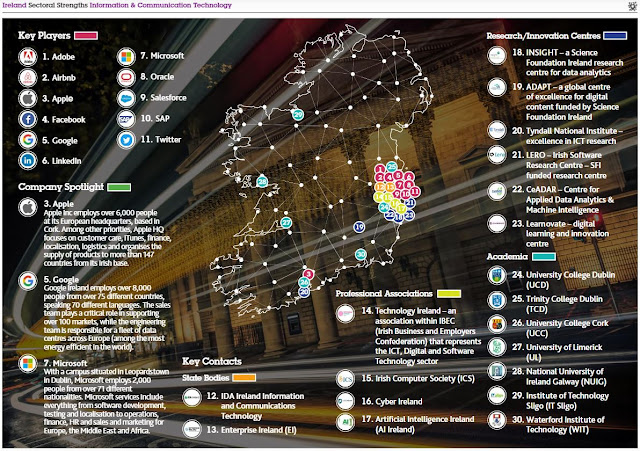
In 2020 Savills — the international real estate firm — gave Dublin a 14th ranking in a Top 20 of global tech cities. Last month Dublin was ranked 4th as one of the lead “European cities of the future” ahead of London, Amsterdam and Paris according to the Financial Times’s FDI Intelligence. The Irish capital was 5th overall in the 'Global Cities of the Future' and 3rd place in the “business friendliness” and “economic potential categories.”

While big tech firms have centralised their European sales and customer support in Dublin, they are also involved in computer programming and software development. Government data for 2020 show that foreign firms had 38,000 people in the latter activities while Irish firms only had 1,700.

Foreign workers accounted for 17% of employment in 2021 (429,000) and the ratio in Information and Technology (ICT) was 35% (breakdown for 2020). ICT is a sub-category of 'Information and Communication' which includes newspapers, broadcasters and telecommunication, and in 2019-2021 40,000 jobs were added.

Saturday, February 05, 2022

Ireland's international economic and social indicators in 2022

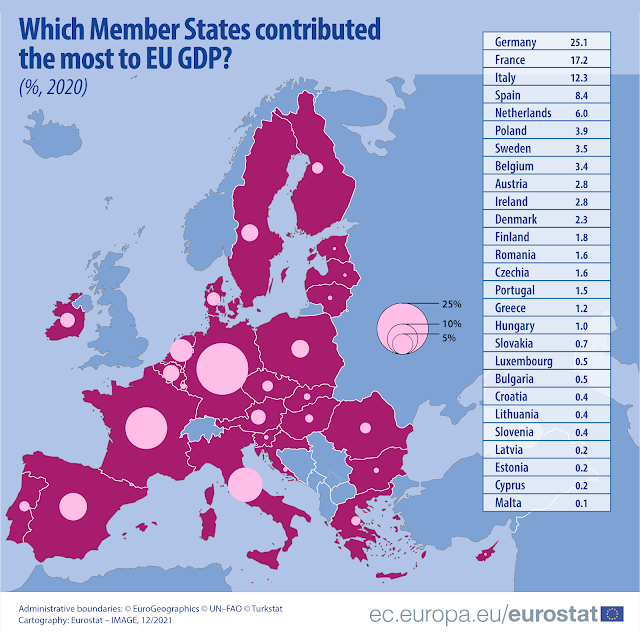
Last year Eurostat reported that in 2020, slightly more than a quarter of the EU’s GDP (gross domestic product) was generated by Germany (25.1%), followed by France (17.2%) and Italy (12.3%), ahead of Spain (8.4%) and the Netherlands (6.0%).

Ten EU member states contributed less than 1% to the EU’s total GDP: Malta (had the lowest share of EU GDP at 0.1%), Estonia, Cyprus and Latvia (all 0.2%), Croatia, Lithuania and Slovenia (all 0.4%), Bulgaria and Luxembourg (both 0.5%), and Slovakia (0.7%).

In the first year of the pandemic, Spain took the biggest GDP hit (-10.8%), followed by Greece (-9.0%), Italy (-8.9%), Portugal (-8.4%), Malta (-8.2%), Croatia (-8.1%) and France (-7.9%).

The only EU country that registered an increase in GDP in 2020 was Ireland (+5.9%).

Friday, February 04, 2022

Birth of James Joyce's Ulysses coincided with genesis of Irish democracy

Sylvia Beach meets James Joyce in her Parisian English language bookshop, Shakespeare & Company in 1922 (the second poster in the background references a 1922 review of 'Ulysses'). She published Joyce's groundbreaking novel 'Ulysses.' on February 2, 1922 — Joyce's 40th birthday. It began to be serialised in the United States in 1918, resulting in a ban that was lifted in 1933.

The 100th anniversary of the publication of the novel 'Ulysses' (the Latinised name of Odysseus, the hero of Homer's epic poem the 'Odyssey') highlights the importance of James Joyce (1882-1941), who is renowned for his experimental use of language together with new literary methods, which he called "scrupulous meanness."

The book was also controversial in prudish times. Belfast-born James Douglas (1867–1940) — a critic, editor of the British Sunday Express, and author — called 'Ulysess':

“The most infamously obscene book in ancient or modern literature. All the secret sewers of vice are canalised in its flood of unimaginable thoughts, images, and pornographic words. And its unclean lunacies are larded with appalling and revolting blasphemies directed against the Christian religion and against the holy name of Christ — blasphemies hitherto associated with the most degraded orgies of Satanism and the Black Mass.”

A US attorney used the quote before the 2nd Circuit Court of Appeals in US v One Book Entitled Ulysses in 1934. A 1933 decision to lift a ban on the book was upheld. In the UK a 1922 censorship ban was lifted in 1936.

'Ulysses' was not banned in Ireland but it was never sold there until decades after its release.

The first publication, in Paris, came two weeks after the British government had ceded Dublin Castle, the bastion of 700 years of rule by Normans, English and British, to the new Provisional Government of the Irish Free State.

'Ulysses' is set on June 16, 1904, when the prospect of a self-governing Irish democracy was extremely remote.

Joyce had a love-hate relationship with Ireland and when he died in Zurich in 1941, he was a British citizen and a British diplomat spoke at the funeral while the Irish taoiseach (prime minister) queried if Joyce had been a Catholic. There was no Irish representation at the funeral.

Sylvia Beach, the American-born publisher of the book, had to support the Joyces through the 1920s but according to 'The New Yorker' "The peak of his prosperity came in 1932 with the news of his sale of the book to Random House in New York for a $45,000 ($916,000 today) advance, which, she (Sylvia Beach) confessed, he failed to announce to her and of which, as was later known, he never even offered her a penny. "I understood from the first that, working with or for Mr Joyce, the pleasure was mine — an infinite pleasure: the profits were for him."

Tuesday, February 01, 2022

US and Chinese ICT and health firms lead global R&D

In December 2021 the European Commission published its annual review of business research and development — both in the Union and across the globe.

At a spending level, the EU remained second to the United States. American and European companies fell slightly to 20.3% and 37.8% respectively while Chinese companies continued to raise spending by reaching 15.5%.

At a global level in 2020 — the first year of the pandemic — business R&D was concentrated in four key sectors accounting for 77.4% of global R&D on the Scoreboard: ICT producers (22.9%), Health industries (20.8%), ICT services (18.6%) and Automotive (15.2%).

Amazon is the world's biggest business R&D spender.

However, it is not on the Scorecard as its "technology and content" expense includes more than R&D. Amazon's SEC (Securities and Exchange Commission) filing reveals a huge expenditure of $42.74bn in fiscal 2020 (11.1% of net sales) on 'technology and content' as compared to $35.93 billion in fiscal 2019. This compares with the top-ranking Alphabet (Google's parent) in the Global 2500 at €22.47bn ($25.62bn) in 2020.

Saturday, January 22, 2022

European countries and exporting champions

Lithuania has the highest rate of two-way traders; Ireland among lowest

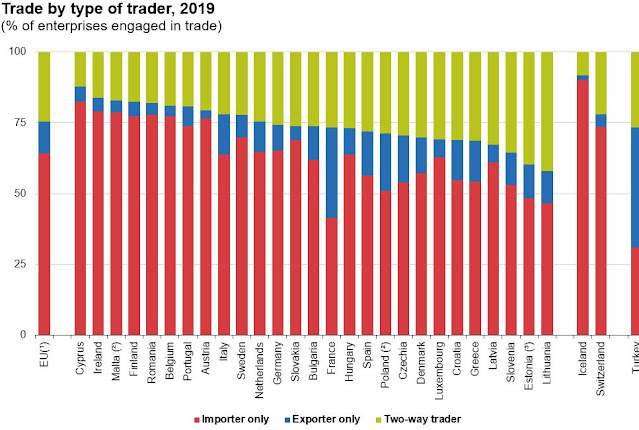
International goods trading is dominated by importers who just only import. In 2019, almost two-thirds of the EU firms were importers only. Domestic firms accounted for the majority of exports while foreign-controlled firms accounted for the majority of imports in the EU in 2019.

According to Eurostat two-way traders (who are importers and exporters) accounted for 24.0% with the remaining 10.6% who were only exporters.

Eurostat says the island nations of Malta (17.0%, 2018 data), Ireland (16.2%) and Cyprus (12.1%) recorded the lowest proportions of two-way traders, as around four-fifths of their enterprises engaged in trade were importers only. The highest share of exporters only was found in France (32.0%) — think of for example wine where it does not require significant foreign inputs.

Ireland's importers accounted for 79% of traders in 2019.

Tuesday, January 11, 2022

Ireland joined the European Economic Community in 1973 as the poorest member

Cover cartoon in the July 1956 edition of the satirical magazine 'Dublin Opinion' — ‘Shortly Available: Underdeveloped Country: Unrivalled Opportunities: Magnificent Views, Political and Otherwise: Owners Going Abroad.’ As the Irish political system remained in a state of stasis, other Western European countries were rebuilding. West Germany recorded a goods trade surplus in 1952 and it has been in the black since. The period 1950-1973 was called the Golden Age of Economic Growth in Western Europe. Real (inflation-adjusted) annual average compound growth rates were unprecedented according to Prof Angus Maddison: Greece grew 6.2% annually; West Germany and Italy expanded by 5% each year; France achieved 4%; Portugal and Spain logged 5.7% and 5.8% respectively. The UK had the lowest rate at 2.5%. Ireland's performance was at 3.1% as was Denmark, Sweden and Switzerland — the latter countries were growing from higher prewar bases. For example, in 1973 Swiss per capita GDP was 138% higher than Ireland's while Denmark's level was 104%.

The Irish Free State (Irish: Saorstát Éireann), a state established in 1922 under the Anglo-Irish Treaty of December 1921, existed from 6 December 1922 – 29 December 1937, when a new constitution became law and the state was called Ireland (Irish: Éire).

The population in 1841 in the area of the island that became the Irish Free State was 6.29m. The devastating Potato Famine of the 1840s followed by huge emigration and a dip in marriage rates, resulted in a population of 3.22m in 1901 and 2.97m in the first census as an independent state in 1926.

The nadir was in 1961 when the population fell to 2.82m.

Sunday, January 02, 2022

The shameful stain of an Irish Civil War 100 years ago

This article was first published in January 2020.
Dublin Castle, the seat of Norman/English and later British rule from 1204-1922 was handed over to the Irish on January 16, 1922, by Lord FitzAlan-Howard, the last Viceroy of Ireland. Michael Collins, the 31-year old chairman of the Provisional Government of the Irish Free State, is pictured 'bouncing’ out through the Chief Secretary’s door after the handover. Collins is preceded by Kevin O'Higgins, who had been appointed Minister for Economic Affairs in the previous week. The new government issued a statement which said, ‘"The Members of the Provisional Government received the surrender of Dublin Castle at 1.45 pm today. It is now in the hands of the Irish nation." A unit of the Royal Corps of Engineers remained at the castle until August 1922. (Image courtesy of the National Library of Ireland)

At 2:20 am on December 6, 1921, British and Irish delegations signed an Anglo-Irish Treaty in 10 Downing Street, London, which provided for dominion status for an Irish Free State comprising 26 counties of Ireland, with a similar status as "the Dominion of Canada, the Commonwealth of Australia, the Dominion of New Zealand, and the Union of South Africa," in the British Empire. The British Government of Ireland Act 1920 had provided for the partition of the island and Northern Ireland comprising 6 counties in the northeast had its own parliament since June 1921.

Wednesday, December 15, 2021

Leprechaun Redux: Ireland's fake €100bn+ of net exports in 2021

A 3D printed Apple logo in front of an Irish flag. REUTERS/Dado Ruvic

In the normal National Accounts of a country net exports (value of exports of goods and services minus the value of imports) is one of the key measures in GDP (gross domestic product). The merchandise or goods exports typically are produced in the country during a quarter or year. However, in Ireland, the National Accounts for 2021 will show that the majority of net goods exports will have been produced in countries such as China. In the first 3 quarters of the year, the net value of goods that physically left Ireland or arrived was €53bn and the net value of goods produced and sold elsewhere was €78bn — the value of the latter that will be in Irish GDP will exceed €100bn for the year 2021 and will be about a quarter of GDP.

I say that the €100bn+ is fake as it is motivated by multinational tax avoidance through profit shifting to Ireland (while the funds could be in a United States bank). The value of the so-called 'exports' is large while the value of so-called 'imports' is very low.

Wednesday, December 08, 2021

Over 10,000 tech startups bought by bigger firms in 2021

Refinitiv, the global financial data firm, says that 2021 has been a record year for mergers and firm acquisitions (M&A) across the world. Refinitiv itself was acquired by the London Stock Exchange Group plc (LSEG) in January.

Refinitiv estimates that in the technology sector the number of deals to buy startups with a value less than a billion dollars, will number about 10,400 in 2021 — that's a rise of over 60% on the pre-pandemic year of 2019.

The level was 6,882 in the dot-com bubble year of 2000, and 2013 was at a decade low of 3,351.

The tech sector now constitutes 20% of the M&A market and with a value of US$888.2bn of announced deals to the end of September, the all-time high for the year will be above $1trn.

Friday, December 03, 2021

Founder conflicts often trigger entrepreneurial failure

Founder conflicts are one of the leading causes of entrepreneurial failure according to The Global Startup Ecosystem Report 2021.

In 2007 Mark Zuckerberg declared “I want to stress the importance of being young and technical ...Young people are just smarter.

However, contrary to the popular myth, researchers say the best entrepreneurs tend to be middle-aged. The French have a saying "si jeunesse savait, si vieillesse pouvait!" (if youth only knew, if age only could!). Typically, entrepreneurs mature and mellow with age!

The average age of successful business founders, based on US Census Bureau data is 45. That’s “among the top 0.1% of startups based on growth in their first five years.” It is 40 years of age for tech startups.

The researchers compiled a list of 2.7m company founders who hired at least one employee between 2007 and 2014.

Wednesday, November 24, 2021

Paddy Cosgrave versus Crony Ireland

The Honorable Society of King’s Inns was founded in 1541 during the reign of Henry VIII (he declared himself king of Ireland in 1542) when the king granted the Society the lands and properties on which the Four Courts now stand, but which were stolen from the Friars Preachers (Dominicans). When the Four Courts were built in the 1790s, King’s Inns moved to Constitution Hill. “Nolumus mutari” is the motto of King’s Inns in Latin and can either mean; “we do not wish to change” or “we do not wish to be changed.” It may also be a response to the removal of some restrictions on Catholic lawyers in 1792. The Inns comprises of benchers, barristers and students. The benchers include all the judges of the Supreme Court, Court of Appeal and High Court and a number of elected barristers. In 2015 after 34 years of reports recommending reforms to the legal profession, the Government surrendered to the legal lobby (see below).

Paddy Cosgrave, the co-founder of the Web Summit, has been campaigning against Crony Ireland in recent times. That depiction of Ireland has a lot of evidence to back it but government leaks are not the greatest evil. In fact, Ireland needs more of them.

Friday, November 12, 2021

Irish digital economy firms account for 1.4% of employment


The Organisation for Economic Cooperation and Development (OECD) has said that "since the mid-1990s, the average real wage has increased by over 50% in Ireland, compared with around 30% in the United States or the average OECD country." The 2018 OECD Economic Survey of Ireland noted that "the vast majority of innovation activities are undertaken in foreign-owned enterprises: research personnel account for less than 1% of the workforce in locally-owned firms ...80% of all patents granted in Ireland are filed by foreign-owned firms. As such, of primary importance for most Irish businesses is the extent to which new innovations are successfully integrated into their operations."

Irish-owned digital economy firms accounted for 1.4% of total employment in December 2020 while the foreign-owned firm rate was 5%.

Total 'Information, Communication & Computer Services' employment including temporary and part-time workers was at 131,600. High tech manufactured products in the 'Computer, electronic and optical products' category had an additional 34,000 employees, resulting in 156,600 or 6.4% of total employment.

The important sub-category 'Computer Programming' had only 1,900 employees in Irish-owned firms while there were 38,000 employed by foreign-owned firms in this area.

Simply, most Irish tech firms do not engage in writing, modifying, testing and supporting software.

Wednesday, November 03, 2021

Japan is most backward advanced country

The empty seat known as the 'gaijin seat' on a crowded Japanese train: This topic was popularised by the Japan Times columnist Baye McNeil. “If you’re a conspicuous non-Japanese living here who rides the trains or buses, or goes to cafés or anywhere in public where Japanese people have the choice of sitting beside you or sitting elsewhere, then you’ve likely experienced the empty-seat phenomenon with varying frequency and intensity.”

The Global Gender Gap Report 2021 published by the World Economic Forum has Japan with the 120th ranking among 156 countries. Angola has the 119th rank and Sierra Leone is at 121th. Just 10 countries have a woman Head of State, and 13 countries have a woman Head of Government and for representation of women in the Lower House of Parliament (Diet), Japan is at the 165 ranking of 190 countries. Naura is at 164 and Qatar is at 166th.

In October 2021 Japan raised the number of female Cabinet ministers by 50%, from 2 to 3 among 22 members.

Friday, October 22, 2021

Deluded Americans and Eastern Europeans shun vaccines

Lack of education, exploitation by right-wing political groups and in the US licensed medical doctors seeking to profit from disinformation, are hampering the vaccination efforts in the United States and Eastern Europe.

In the United States a report this year based on analysis of a sample of anti-vaxx content that was shared or posted on Facebook and Twitter showed up to 65% of anti-vaccine content can be traced to the leading online anti-vaxxers, who are labelled the Disinformation Dozen. The group is comprised of physicians, anti-vaccine activists and people known for promoting alternative medicine. They profit from their lies and this week Drew Griffin, a CNN reporter, told one of them, Dr Rashid Buttar, in an interview, "I think you're crazy." Buttar likened Dr Anthony Fauci — presidential adviser and director of the National Institute of Allergy and Infectious Diseases — to Adolf Hitler, saying the number of deaths caused by Fauci will exceed those of the Holocaust.

Monday, October 18, 2021

Climate perception gaps and individual carbon footprints

The majority of people cannot identify which lifestyle moves are the most effective at limiting their carbon footprint, according to an Ipsos polling survey of more than 21,000 people across 30 countries, which was published in 2021. Nevertheless, an overwhelming number claim they know which personal actions would make a significant difference in tackling climate change.

This year's Perils of Perception study by Ipsos looks at how the public in 30 markets around the world perceives environmental action. The Global Market Average was 7 in 10 (69%) who agreed that “I understand what action I need to take to play my part in tackling climate change.” Confidence was highest in Peru (85%), Colombia (83%), Mexico and Chile (both 82%) and lowest in Japan (40%) and Russia (41%).

The most popular remedies for individual reduction of greenhouse gas emissions (GHG) were among the least effective.

Ipsos, headquartered in Paris, is the 3rd largest global market research company. 

Saturday, October 09, 2021

Tax reforms and challenges for the Irish economy in 2022 and beyond

The Irish Government's decision to sign on to the OECD-G20 international tax reform package which is expected to be approved at the end of October at a summit in Rome may cost more than the estimate of €2bn annually in Irish corporation tax receipts, that has been suggested. It assumes that the €20bn in tax windfalls in 2015-2020 resulting from Apple and other big US companies allocating some of their intellectual property to Ireland, will continue.

The Double Irish tax dodge has ended and other shifted profits that have been diverted to Ireland and taxed, may over time be a problem for the Irish Exchequer.

These changes will happen at a time when there is pressure to raise public spending in several areas.

Irish finance minister's October 2021 statement and a statement from the OECD.

Only 12% of the sales of American majority-owned foreign affiliates go to the United States while local sales are almost 60%. The rest go to other foreign affiliates.

It remains to be seen how more honest reporting in big countries in respect of reported profits will impact decisions.

Last April the US Treasury named Bermuda, the Caymans, Ireland, Luxembourg, the Netherlands, Singapore, and Switzerland as the top 7 corporate tax havens. Their share of US multinational corporation foreign profits has risen from almost 30% in 2000 to over 60% in 2019.

Tuesday, October 05, 2021

Two-thirds of developing countries dependent on commodities

Minera Escondida, located in Antofagasta, Chile, is the world's largest copper mine, producing almost 5% of the world's supply of metal. BHP manages the operation and holds a roughly 58% stake. Other investors include Rio Tinto Plc and Japan's Mitsubishi Corp. BHP is an Anglo-Australian multinational (it plans to delist in London) mining, metals and petroleum giant.

Be it food production, mining, the lithium that charges our smartphones and the oil that still mainly fuels most of our transport, commodities are an important part of modern life. Two-thirds of developing countries are dependent on commodities and for example, all the 12 independent countries of South America (French Guiana with a population of 313,000 is excluded) are dependent. This is defined by the United Nations agency UNCTAD (United Nations Conference on Trade and Development) as a country with more than 60% of its total merchandise exports comprising commodities.

Friday, September 24, 2021

Mikis Theodorakis (1925-2021)

Michail "Mikis" Theodorakis, the renowned Greek composer died earlier this month, at the age of 96. He was best known for the musical score for the 1964 film "Zorba the Greek" which is likely the best-known piece of Greek music in the world.

Tuesday, September 14, 2021

Irish leader de Valera a godfather of IRA - Sinn Féin violence 1970-1998

President de Valera kisses the ring of John Charles McQuaid, Catholic Archbishop of Dublin, at the Turning of the Sod ceremony for the new University College Dublin (UCD) campus at Belfield in South Dublin, September 1962 UCD Archives

Éamon de Valera (1882-1975) was the most consequential Irish political leader of the 20th century who held high office as taoiseach (prime minister) and president for 35 of the 41 years in the period 1932-1973. He had three particular obsessions 1) searching for proof that his claimed Spanish father Vivion de Valera (Valero) was not a fiction and had been married to his mother when de Valera was born in New York 2) the revival of the Gaelic language and 3) the ending of the political Partition of the island of Ireland.

He failed in all three objectives.

De Valera had a deeply long-term hostile attitude to the Belfast government and he even travelled as far as New Zealand to lobby the British government to support a United Ireland.

Wednesday, September 01, 2021

Climate change challenges of the 21st century

The Moon and Earth's Troposphere: Silver-blue noctilucent clouds are shown extending far above the orange-coloured troposphere, the lowest and densest part of Earth's atmosphere. Photo: by NASA taken by the Expedition 28 crew (began May 2011) aboard the International Space Station.

July 2021 was Earth’s hottest July since global record-keeping began in 1880. July had two $25bn flood disasters and the Earth’s hottest "reliably measured temperature on record" was 54.4°C (130°F) at Death Valley, California." July 2021 was the sixth wettest July on record in the US.

Lytton, West Canada, had a temperature of 49.6°C on June 29 (a record beaten 3 consecutive days); Morocco: 49.6°C at Sidi Slimane, July 10 and the United Arab Emirates: 51.8°C at Swiehan, June 6.

Temperatures for Verkhoyansk, a remote Siberian town inside the Arctic Circle, hit 38°C on June 20, about 18°C above the average maximum daily temperature in June.

Fires ravaged forests in many parts of the globe.

Among EU27 countries Ireland had the highest per capita greenhouse gas emissions in 2019 at 12.8 tons of CO₂ equivalent which includes the main greenhouse gases. The EU27 was at 8.4; Germany at 10.1; Denmark 8.1; Sweden 5.2 and non-member the UK at 7.3. See chart. Luxembourg data are not reliable as over 40% of its workforce live in neighbouring countries.

The category is 'Total emissions and international aviation.' See the European Environmental Agency chart below. *Also check the detail of the dataset at end of the page.

Greenhouse gases make the Earth habitable but concentrations have risen 50% after a period of 800,000 years

Thursday, August 12, 2021

Political Comedy & Satire: Yes Minister and Yes Prime Minister

Thirty-five years ago on January 9th 1986 Michael Heseltine, British Defence Secretary, gathered his papers at a meeting of the Cabinet and stormed out of 10 Downing Street. He and Margaret Thatcher, the Prime Minister, had disagreed on the procurement of military helicopters.

The ministerial resignation dominated the BBC's Nine O'Clock News that evening while on BBC 2 at the same time the new fictional PM, Jim Hacker MP, was being briefed at the Ministry of  Defence on the nuclear deterrent and a possible response to a Russian attack. He is told he would only have 12 hours to decide whether or not to push the nuclear button. Back in Downing Street the Chief Scientific Adviser quizzes the befuddled Hacker on when he would launch nuclear missiles (see The Grand Design below).

There were also early echoes of Brexit, 30 years before the 2016 referendum on leaving the European Union (EU). In 1983 Labour's election manifesto 'New Hope for Britain' had a commitment on leaving what was then known as the European Economic Community (EEC), 8 years after Britain's first ever national referendum, on membership ─ Labour MP Sir Gerald Kaufman (1930-2017) called the left-oriented manifesto "the longest suicide note in history."

Yes Minister was broadcast in 1980-1984 and a one hour Christmas special in December 1985 revealed the victory of the surprise compromise candidate as Prime Minister, following his campaign among party members to save the British sausage. "I believe in the European ideal... but this does not mean that we have to bow the knee to every directive from every little bureaucratic Bonaparte in Brussels... They've turned our pints into litres and our yards into metres; we gave up the tanner and the threepenny bit, the two bob piece and the half crown. But they cannot and will not destroy the British sausage." 

Saturday, August 07, 2021

8.4% of world population live in a full democracy including Ireland

Among the world's top 10 most populous countries India and the United States in the past stood out as free democracies. Neither is today. While both Narendra Modi and Donald Trump know that racism can be a potent tool, the process of moving to authoritarianism was in place before they won national power.

China (1) and India (2) account for 36% of the global population. They are followed by the US (3); Indonesia (4); Pakistan (5); Brazil (6); Nigeria (7); Bangladesh (8); Russia (9) and Mexico (10).

Accounting for 58% of the global population of 7.79bn in 2020, none of the countries is a full democracy.

Western Europe is the crucible of global democracy but the long peace between European powers since 1945 and the relative peace of the Pax Romana (Latin for Roman Peace) of 27 BCE-180 CE (common era) bookends a history of carnage (Caesar Augustus, also known as Octavian, was the first Roman emperor and he reigned from 27 BCE until his death in CE 14. He did engage in wars.)

War has been a hallmark of humanity in history compared with peace and for 157 years a set of statistics has grabbed the attention of military leaders, US politicians, and academics who do not check sources and many book authors: In 3,400 years only 268 have been peaceful.

The 1932 book 'Inevitable War' has 3,421 years during which about 8,000 peace treaties were concluded, and in which time there were only 268 years of peace or 8%. The historians, Will Durant and his partner Ariel, have a line in 'Living History'(1968) that “In the last 3,421 years of recorded history, only 268 have seen no war,” without attribution. Barry O’Neill of the University of California, Los Angeles, in a 2014 paper noted "In 1996 Donald Kagan, a classicist at Yale, testified before the House Committee on National Security. Those hoping for permanent peace have forgotten that war is ingrained in civilization," he argued. Kagan had given the 268-years -of-peace count in his 1995 book, "On the Origins of War," quoting Durant's 1968 book.

Chris Hedges in The New York Times in 2003 uses the more common 3,400 statistic.

A 1931 French essay cited the statistics adjusted to 1925 from original fraudulent data. The "magical figures" date to 1864 when an obscure French philosopher, François Odysse Barot, set out the data for 1496 BCE to 1861 in "Lettres Sur la Philosophie de L Histoire" with 3,357 years of war and 227 years of peace. He claimed to have counted 8,397 peace treaties which were later expanded but Barot had engaged in a hoax.

Since 1945 Western Europeans have lived through the longest period of peace between major powers in 2,000 years of recorded history.

There are fears that rivalry between the United States and a rising China could lead to war.

Sunday, August 01, 2021

On the origin of humans and evolution

Humans, chimpanzees and bonobos were descended from a single ancestor species that lived 6 to 7m years ago. Humans and their closest cousins share 98.8% of their DNA, according to the American Museum of Natural History. The same DNA can behave differently — we share about 96% of our DNA with gorillas.

Charles Darwin (1809-1882) in his 1871 book 'The Descent of Man,' speculated that it was “probable” that humans originated in Africa because our two closest living relatives — chimpanzees and gorillas — live there. However, he also acknowledged that a large extinct ape once lived in Europe millions of years ago, leaving time for our earliest ancestors to move to Africa. Darwin concluded, “it’s useless to speculate on the subject.”

We now know the location of the cradle of humanity and at least 21 human groups can be identified from 6 to 7m years ago to modern humans that have developed from about 300,000 years ago.

What we also know is that Homo sapiens (Latin: “wise man”) is the species to which all modern human beings belong and that is among the genus Homo (man or human).

Homo sapiens is the only group that is not extinct.